Extended Reality Environments: Building Immersive Virtual Spaces
~2 min read
xrvrarmetaversexrenvironmentsvirtual-realityaugmented-realityspatial-computing
Save products you love by clicking the heart icon.
We use privacy-friendly analytics (Plausible + Umami) to understand how visitors use this site. No analytics are loaded without your consent. Privacy Policy
Comprehensive guide to WebXR hit testing and depth sensing — ray intersection, transient hit tests, reading the depth buffer, occlusion rendering, and mesh reconstruction for real-world interaction.
A practical deep-dive into the WebXR Hand Tracking API — joint positions, pinch detection, custom gesture recognition, and interaction patterns for immersive VR applications.
Extended Reality (XR) is an umbrella term encompassing Virtual Reality (VR), Augmented Reality (AR), and Mixed Reality (MR). These digital ecosystems redefine human-computer interaction by creating immersive and interactive experiences.
XR environments integrate digital elements with the physical world to varying degrees:
Platforms like Mozilla Hubs exemplify how XR transforms remote collaboration. Teams can interact in shared 3D spaces, manipulate virtual objects, and experience a stronger sense of presence than traditional video conferencing.
XR provides safe, repeatable, and high-fidelity training for critical sectors like medicine, aviation, and heavy industry. Surgeons practice procedures, pilots simulate emergencies, and students explore complex concepts immersively.
XR enables the creation of "Digital Twins" for physical assets and infrastructure. These virtual replicas allow for real-time monitoring, performance simulation, and "what-if" scenario planning without real-world risk.
Advanced XR environments enable sophisticated training and simulation applications across industries. Through immersive virtual scenarios, professionals can practice complex procedures, explore technical concepts, and develop skills in safe, controlled environments that replicate real-world conditions.
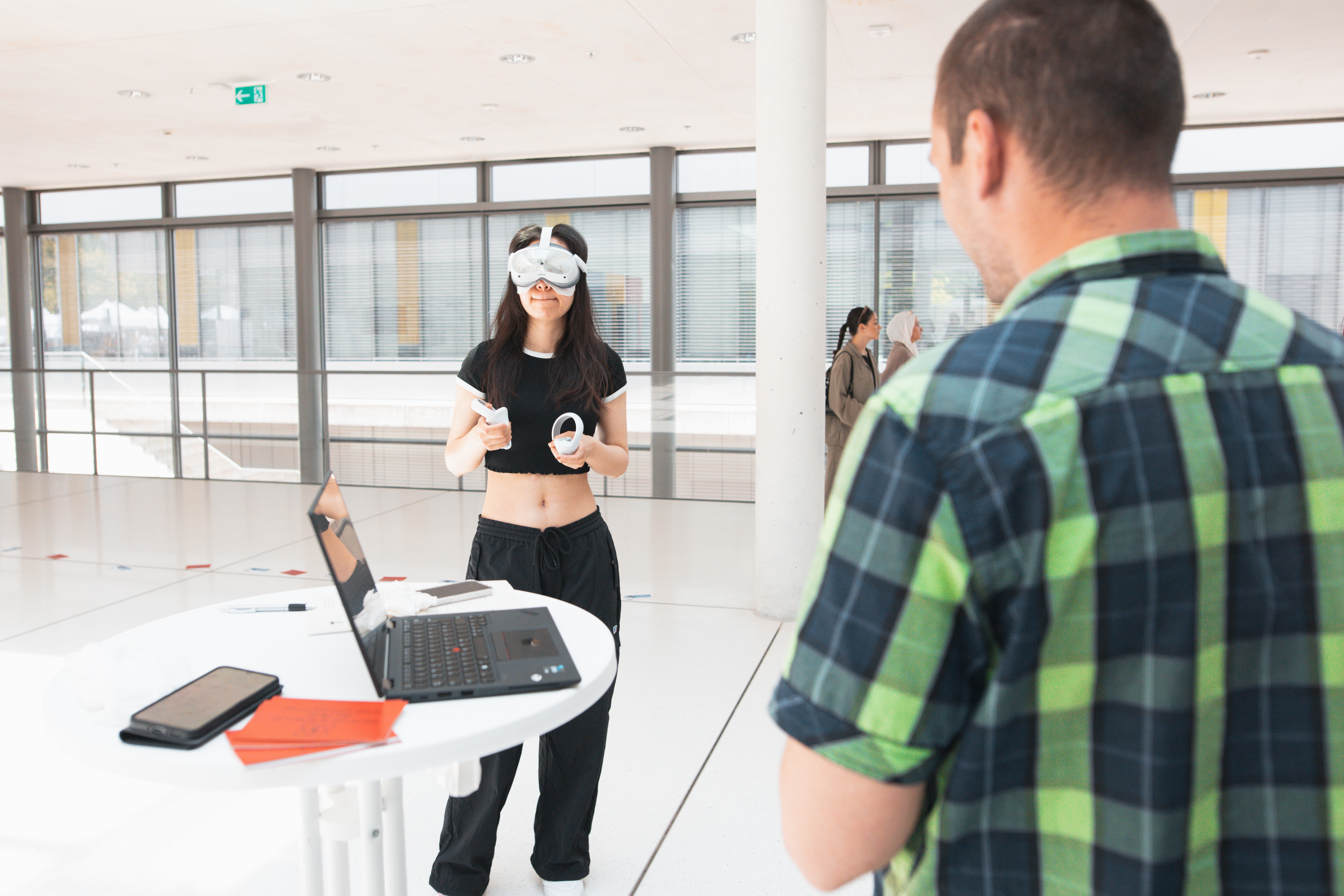
These implementations showcase how XR environments transform professional development and technical training, making complex procedures and abstract concepts more accessible through hands-on, experiential learning.
As XR hardware advances (lighter, more powerful devices), XR environments are poised to become pervasive interfaces. The paradigm is shifting towards Spatial Computing, where digital information is seamlessly integrated into our physical surroundings.
We champion the development of open and sovereign XR environments, empowering users and businesses to control their digital futures.