Grundschutz++ Explained: The New BSI Standard 300-1 and What Changes for Your ISMS
🇩🇪 Auf Deutsch lesen~8 min read
securitycompliancepublic-sectorbsigrundschutzgppismsiso-27001nis2oscalcompliance
Part of the Content index — see also Compliance Without the Merry-Go-Round: BSI C5:2026, NIST and CCM.
Source: BSI-Standard 300-1 „Methodik Grundschutz++" (PDF).
On 26 October 2026 the German Federal Office for Information Security (BSI) published BSI-Standard 300-1, the methodology of Grundschutz++ — the biggest overhaul of IT-Grundschutz in its 30-year history. Modules and protection levels are out; a process-oriented ISMS with a machine-readable requirements catalogue is in. Certification becomes possible on 1 January 2027; the classic IT-Grundschutz remains certifiable until 30 November 2031.
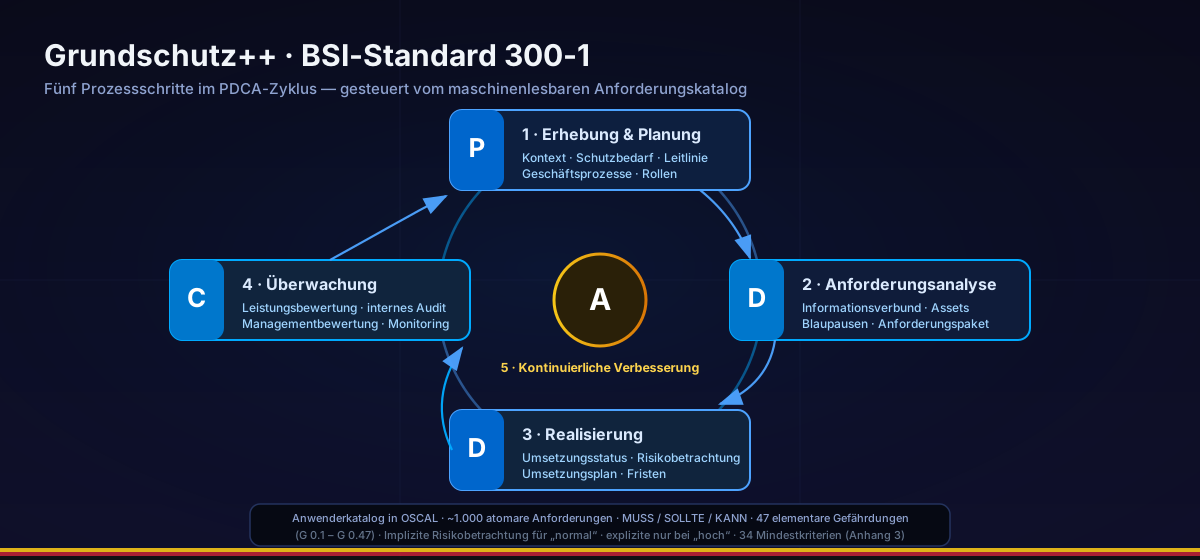 Diagram: Grundschutz++ replaces the module-based IT-Grundschutz with five PDCA process steps — Erhebung & Planung, Anforderungsanalyse, Realisierung, Überwachung, kontinuierliche Verbesserung — driven by the machine-readable Anforderungskatalog
IT-Grundschutz is the BSI's baseline methodology for information security — for 30 years the de-facto reference for German public administration and, increasingly, for companies that serve it. The classic approach (Standards 200-1 to 200-3 plus the IT-Grundschutz-Kompendium) is built around modules (Bausteine): organise your systems into modules, apply the linked safeguards, done. It worked — but it grew unwieldy. Thousands of safeguards, protection levels, and a static, document-based Kompendium that was hard to keep current and impossible to automate.
Grundschutz++ is the answer to four pressures:
| Dimension | Classic IT-Grundschutz | Grundschutz++ (Standard 300-1) |
|---|---|---|
| Focus | IT systems / modules | Business processes (assets follow) |
| Structure | Kompendium, ~100+ Bausteine | 5 PDCA process steps |
| Catalogue | Static documents | Machine-readable (OSCAL) requirements |
| Protection needs | normal / high / very high | normal / high |
| Risk assessment | Mandatory for all | Implicit (BSI) for normal; explicit only for high |
| Method | Fixed BSI method | Free choice, 34 minimum criteria (Anhang 3) |
| Certification | From day one | From 1 Jan 2027; transition until 30 Nov 2031 |
Grundschutz++ is organised as a Plan-Do-Check-Act cycle with exactly five process steps. Every step is described in the standard as a set of formalised requirements — the same "sentence template" language used throughout the catalogue:
The most radical change is the Anwenderkatalog that replaces the IT-Grundschutz-Kompendium. It ships in OSCAL (the NIST open format for security catalogues) and every requirement is atomic with structured metadata:
| Field | Meaning | Example / values |
|---|---|---|
id, title | Unique identity, e.g. UMS.1.1 | ~1,000 requirements |
modal_verb | Binding force | MUSS (149) / SOLLTE (627) / KANN (224) |
sec_level | Security level | normal-SdT (state of the art) / erhöht |
categories | Target-object categories the requirement attaches to | e.g. application, IT system, room |
params | Open parameters such as "regelmäßig" — you set the value | <param> placeholder |
threats | Linked elementary threats (G 0.1 – G 0.47) | traceable chain to risk |
effort_level | 0–5, 0 = mandatory, 1 = quick win … 5 = complex | drives prioritisation |
sec_data | Effect on confidentiality / integrity / availability | 0–2 per security goal |
Three types of requirements:
The exact numbers (149 / 627 / 224) come from independent analyses of the released OSCAL catalogue — the PDF ships the counts machine-readable in the data model, not as headlines. (Roughly 1,000 requirements in total; of the 773 at the "normal" security level, the rest are "erhöht".)
Grundschutz++ flips the risk model:
Instead of "pick modules", you now build an Anforderungspaket (requirements package) from three sources:
Blaupausen (blueprints) are pre-configured slices of the catalogue for recurring scenarios with parameters pre-set. For some institutions mandatory blueprints may exist; otherwise you select, document, and combine multiple blueprints. Customise an individual requirement with parameters ("regelmäßig" → "quarterly", "monthly"…) at package creation.
A slim, technology-neutral list of 47 elementary threats replaces the sprawling legacy threat catalogues. Each requirement in the catalogue is linked to the threats it mitigates — so you can always trace why a requirement exists, and reuse the mapping in your own risk assessments. Threats are grouped along the classic categories: higher force, organisational shortfalls, human error, technical failure, and deliberate acts.
For institutions already certified on classic IT-Grundschutz: you have a transition runway until 30 November 2031. Don't panic-migrate; do start a delta analysis — most evidence carries over, and the ISO/IEC 27001 alignment means your existing ISMS documentation maps almost 1:1.
For newcomers: this is the cheapest clean start the BSI has ever offered — implicit risk assessment for the 90% of your processes that are "normal" removes the historically biggest blocker to getting certified.
For tool and GRC vendors: the OSCAL catalogue is the real prize. Requirements are now data: filter, prioritise, and map them automatically — no more scraping a 2,000-page PDF. Standards tell you the model; the market now builds the tools.
Timeline:
| Date | Event |
|---|---|
| 20 Oct 2026 | Standard 300-1 v1.0 published (PDF) |
| 26 Oct 2026 | BSI announcement |
| 1 Jan 2027 | Certification per Grundschutz++ possible |
| Q1 2027 | Training for certified advisors / audit-team leaders |
| 31 Dec 2027 | Early-adopter phase ends |
| 30 Nov 2031 | End of certification per classic IT-Grundschutz |
Bottom line: Grundschutz++ is not a facelift — it is a different operating model for German information security: process-first instead of module-first, machine-readable instead of document-based, and risk-appropriate instead of uniform. If your institution lives anywhere in the German public sector, NIS2, or KRITIS, this is the standard you will certify against for the next decade.
November 14, 2026. Read the standard yourself: BSI-Standard 300-1 „Methodik Grundschutz++" (PDF). For the cloud side of German compliance, see C5:2026, NIST and CCM.