Symmetry and the Machine: From Plato's Proportions to Equivariant AI
🇩🇪 Auf Deutsch lesen~11 min read
philosophymathematicsphysicsaisymmetrylie-groupsnoetherequivariancegroup-theorygeometric-deep-learning
Part of the Philosophy section.
Hermann Weyl, mathematician, physicist, and the century's deepest philosopher of the subject, put it bluntly: "As far as I see, all a priori statements in physics have their origin in symmetry." That single sentence binds together everything in this article — the Greek sense of beautiful proportion, the group theory Galois invented for equations, the Lie groups that build the Standard Model, and the equivariance inside modern neural networks.
Strip away the decoration and symmetry is a single, exact idea: a thing is symmetric under a transformation if that transformation leaves it unchanged. A snowflake looks the same after a sixth-of-a-turn rotation. A circle looks the same after any rotation, any mirror, any translation of its centre. The equation x² + y² = r² does not change if you swap x and y. The universe does not change if you slide everything three metres to the left. Each of these — the flake, the circle, the equation, the cosmos — is "symmetric" in exactly the same technical sense: invariant under a transformation.
The word itself comes with the whole Western metaphysics attached. Greek symmetria (συμμετρία) meant "measured together" — commensurability, right proportion, the harmony of parts in a whole. It was never merely decorative. From the start, symmetry was the claim that the beautiful, the true, and the structurally sound were the same thing, expressed as ratios.
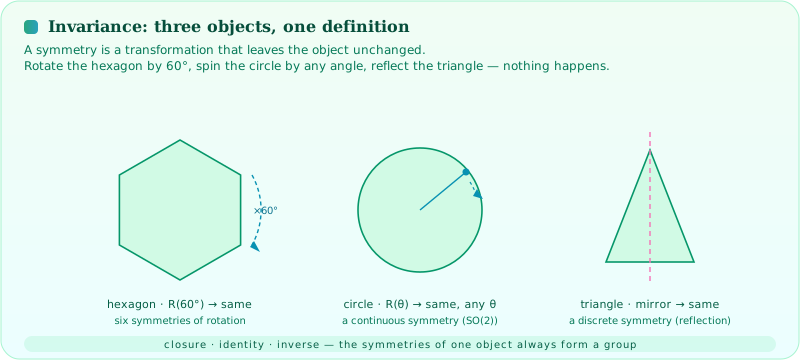 Three objects, one definition: a hexagon unchanged by 60° rotation, a circle unchanged by any rotation, a triangle unchanged by reflection
Heraclitus adds the dark footnote that belongs in every honest treatment: the deepest harmony is hidden — a tension of opposites (κρυπτὴ ἁρμονίη), like the bow and the lyre. Symmetry is not blandness; it is a poised contradiction, and the "balance" is doing the work. We will need Heraclitus again when we reach broken symmetry and machine learning, so keep him in mind.
The modern move is to take the definition — invariance under transformation — and make the transformations themselves the object of study. A set of symmetries of an object always has a structure: do two symmetries in a row and you get another one (closure); every symmetry can be undone (inverse); doing nothing counts (identity). This structure is called a group, and it is arguably the deepest successful abstraction in mathematics: a "measure of sameness."
One lesson to take forward: studying something often means finding what does not change when you transform it. Invariants are how mathematics gets a grip on a thing at all.
In 1918, Emmy Noether proved the theorem that makes symmetry the grammar of physics: every continuous symmetry of the laws corresponds to a conserved quantity. Time-translation invariance → energy is conserved. Spatial translation → momentum. Rotation → angular momentum. Gauge symmetry → charge. The theorem is the reason physicists classify theories by their symmetry groups: the symmetries are the laws, in the strong sense that they generate the conservation laws that organise everything else.
Continuous symmetries bring continuous groups — Lie groups, named for Sophus Lie, who invented the theory of symmetries of differential equations in the 1870s (the same lineage that today powers Lie point symmetry methods and some equivariant networks). The physics catalog:
The rotation group SO(3) and the Poincaré group (rotations + boosts + translations) organise non-relativistic and relativistic mechanics.
Gravity, in Einstein's general relativity, is almost nothing but symmetry: the theory is built to be invariant under every smooth coordinate transformation (diffeomorphism invariance / general covariance). Where other forces act in spacetime, gravity is the geometry of spacetime, forced into existence by demanding the symmetry. Weyl's remark about a priori statements finding their origin in symmetry is nowhere truer.
The Standard Model of particle physics is a gauge theory: it is built by demanding invariance under the local (position-by-position) symmetry groups U(1) × SU(2) × SU(3), and the forces — electromagnetism, the weak and strong nuclear forces — arise as the "compensation fields" forced into existence when you demand that symmetry hold locally. Hermann Weyl and Yang–Mills turned Galois' trick (study the object via its symmetry group) into the entire framework of fundamental physics. The price of local symmetry is a force.
Broken symmetry. The world we actually live in is not as symmetric as the laws that generate it. Crystals are less symmetric than the space they form within; a spun-out liquid crystallises and loses rotation invariance. In particle physics, spontaneous symmetry breaking (the Higgs mechanism) gives masses to particles while the underlying gauge symmetry stays exact. The universe's early, maximally symmetric state cooled into the differentiated one we inhabit. Heraclitus was right: the harmony is hidden, and what looks like "less symmetry" is where structure comes from.
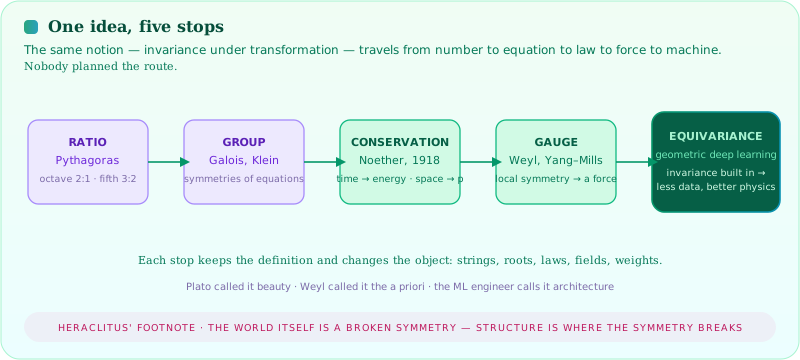 The route of one idea through five stations: ratio, group, conservation, gauge, equivariance
Now bring the whole apparatus to the machine — because symmetry, which used to live in aesthetics and physics, has become an engineering concept in AI, and engineers discovered the same thing Plato claimed: symmetric structure is not decorative, it is the most efficient true.
Symmetry as inductive bias. A neural network knows nothing a priori; it must be told, or shown, the invariances of the world. The classic case is the convolutional neural network: the reason a CNN recognises a cat no matter where in the image it sits is that the architecture builds in translation equivariance via shared weights — the same filter applied at every position. It does not learn that translation is a symmetry; it is that symmetry, in silicon. Contrast the transformer: it needs positional encodings precisely because it is not naturally invariant under reordering — order had to be hand-wired in as a discrete symmetry that is only approximately respected. Every data-augmentation pipeline (rotate, flip, crop the training images) is a soft version of the same move: teaching invariance statistically, by example, instead of architecturally, by construction.
Equivariant deep learning. The last decade of "geometric deep learning" made the move explicit and general. Group-equivariant CNNs, steerable CNNs, E(n)-equivariant graph networks, tensor field networks for molecules, and Lie-symmetry-aware architectures all insist that the network's internal maps commute with the symmetries of the problem — rotations, permutations, translations — and only then let the network learn the rest. The results are striking where physical symmetry dominates: molecular and crystal property prediction generalises dramatically better with built-in equivariance, because the network never wastes capacity re-learning that rotating a molecule doesn't change its energy. When the symmetry is right, you need far less data: symmetry is the ultimate regulariser. Noether's theorem has a machine-learning twin: a model whose architecture respects a symmetry conserves that inductive capacity — it cannot un-learn the conserved quantity, because it has no parameter that could.
Symmetry in the training process itself. Even unconstrained networks are governed by symmetry: permuting the neurons of a hidden layer yields a different parameter vector but the identical function, so the loss landscape is riddled with exact equivalences (permutation symmetry of weights). Optimisation, mode connectivity, and distillation all have to grapple with the fact that "the model" is not a point in parameter space but an equivalence class under symmetry. The machine, it turns out, has its own hidden harmonies.
Representation, sets, and what the model is allowed to ignore. Modern architectures encode assumptions about which transformations should and should not be symmetry of the task: set transformers are built to ignore order (permutation-invariant by construction) while language models are built to care about it. The designer's real question is always the philosophical one: which invariance do we believe in? Believing a symmetry is an a priori commitment about what the world does not care about — and getting it wrong is how models fail in ways no amount of data fixes, because you cannot sample your way out of a symmetry the architecture forbids (or enforces against the world).
Go back to the opening. "All a priori statements in physics have their origin in symmetry." The line ran forward from Pythagoras' ratios, through Plato's solids and Kant's wallpapers, through Galois' groups and Noether's theorem, into the Lie-group gauge theory of the Standard Model. Now it runs into the machine. A convolutional network's translation equivariance is an a priori commitment — about the world before any data — mechanically enforced. Equivariant networks generalise this: the model declares its belief about what is invariant, and the data can only fill in the gaps between the symmetries.
So the oldest philosophical claim in the West — that the true, the beautiful, and the well-structured are the same, and can be known in advance — has, in roundabout fashion, become an engineering fact. Plato said the proportions are prior to experience. Weyl said the a priori is symmetry. And a modern ML engineer says the same thing in the vocabulary of equivariance: the strongest knowledge is the invariance you build in, not the pattern you learn. The machine did not refute the philosophy of symmetry; it industrialised it.
The section's working question is how we relate to the machines we build. The honest answer, regarding symmetry: we build them in our own oldest image — as seekers of what does not change. Unless, with Heraclitus, what we really build is the tension, and the beauty is in the breaking.
For the mathematics-as-philosophy thread, see the Riemann Hypothesis and Graph Neural Networks research.