Alcoholism and Sexual Abuse in Academic Circles: The Institutional Architecture of Enablement
ResearchSociety & CultureAbstract
Academic institutions present themselves as meritocratic spaces governed by reason, ethics, and due process. Behind this facade runs a parallel system — one in which alcohol fuels social bonding and abuse finds cover in institutional opacity. This paper examines the structural conditions that enable alcoholism and sexual abuse to persist in higher education, drawing on prevalence data, institutional analysis, and documented failure patterns. We argue that the current system does not fail randomly — it is organised in ways that systematically protect institutional continuity over individual safety.
The Unspoken Curriculum
Every university publishes a code of conduct. Every faculty handbook contains an ethics section. Every new student sits through an orientation module on consent, harassment policies, and reporting procedures. These documents describe the university as it wishes to be seen: a safe, rational environment where misconduct is investigated and punished.
The reality, documented across decades of research, is different. In the United States, one in four undergraduate women experiences sexual assault during their academic career [1]. Among graduate students, 38% report experiencing sexual harassment from faculty or staff [2]. In Europe, the 2024 UniSAFE survey across 46 institutions found that 62% of respondents had experienced some form of gender-based violence — with alcohol identified as a contributing factor in over 40% of cases [3].
Alcoholism follows a similar pattern of institutional denial. Studies consistently find that faculty members consume alcohol at rates comparable to or exceeding the general population, with binge drinking particularly prevalent at academic conferences [4]. The "conference drink" is not a side effect of academic culture; it is a feature — a lubricant for networking, a ritual of collegiality, and, for those who decline, a subtle marker of not belonging.
This article does not argue that academia is uniquely corrupt. It argues that academia is uniquely structured to allow these problems to persist, and that understanding that structure is the prerequisite to meaningful reform.
The Data They Do Not Publish
Prevalence data on sexual abuse in academic settings is more comprehensive than most faculty members realise — and worse than most administrators acknowledge.
Sexual Abuse Prevalence
| Population | Prevalence | Source |
|---|---|---|
| Undergraduate women (US, 4-year) | 23–26% experience sexual assault | AAU Campus Climate Survey (2019) |
| Graduate/professional students | 9.7% experienced non-consensual sexual contact | AAU (2019) |
| Female STEM faculty | 50%+ experienced sexual harassment | NASEM (2018) |
| LGBTQ+ students | 2x higher rates vs. heterosexual peers | CDC (2023) |
| Students with disabilities | 3x higher rates vs. non-disabled peers | RAINN (2024) |
The AAU survey, one of the largest of its kind, sampled over 180,000 students across 33 US universities in 2019 [1]. Its findings are considered conservative — the survey defined sexual assault narrowly (penetration or touching without consent) and excluded students who did not complete the survey, a group that likely includes higher proportions of survivors who find the topic triggering.
Alcoholism and Hazardous Drinking
Alcohol prevalence in academia is harder to quantify because it is so thoroughly normalised. The data that exists focuses on students:
| Population | Hazardous Drinking Rate | Source |
|---|---|---|
| US college students (past-month binge) | 33% | NIAAA (2023) |
| Graduate students | 22% report AUD symptoms | BMC Public Health (2024) |
| UK academics (hazardous drinking) | 27% | UCU Survey (2023) |
| Academic conferences (binge episodes) | 41% of attendees | Addictive Behaviors (2022) |
Among faculty specifically, data is sparse — precisely because the question is rarely asked. A 2023 survey of UK academics found that 27% scored above the threshold for hazardous drinking on the AUDIT-C, with male professors and early-career researchers at highest risk [5]. The study noted that alcohol consumption was "deeply embedded in academic working practices, particularly networking, collaboration-building, and post-conference socialising."
The Dark Figure
Both alcoholism and sexual abuse share a critical feature: official statistics capture only a fraction of actual incidents. For sexual assault in academic settings, reporting rates range from 5% to 20% depending on the institution and type of assault [1]. For hazardous drinking among faculty, no systematic reporting mechanism exists at all — there is no equivalent of Title IX for substance abuse.
The reasons for underreporting are identical in both cases:
- Fear of professional retaliation
- Belief that nothing will be done
- Normalisation of the behaviour
- Concern about confidentiality in small departments
- The perpetrator's status as a "valuable" faculty member
The Architecture of Enablement
The question "why does abuse persist in academia?" is usually answered with individual cases: a specific professor, a specific department, a specific failure of oversight. But individual cases, when stacked together, reveal a pattern. That pattern is not accidental. It is the predictable output of an institutional architecture designed — whether explicitly or through historical accretion — to protect the institution from liability rather than to protect individuals from harm.
Tenure as Insulation
Tenure was created to protect academic freedom: the right to pursue unpopular research, challenge orthodoxies, and speak truth to power without fear of termination. That protection was necessary in the McCarthy era and remains necessary today. But tenure, as currently structured, also insulates abusive behaviour.
A tenured professor who engages in sexual harassment faces a disciplinary process so baroque that most institutions choose not to pursue it. At public universities in the US, the process typically involves:
- An informal complaint to the department chair
- A formal complaint to the Title IX office
- An investigation (90–180 days)
- A faculty committee hearing
- A recommendation to the dean
- A recommendation to the provost
- A vote by the board of trustees
- Potential appeal to a state court
Each step offers opportunities for delay, procedural objection, and reversal. The burden of proof is not "preponderance of evidence" (the civil standard) in practice — it has become, through accumulated procedural safeguards, closer to "clear and convincing evidence," a standard that most institutions cannot meet without a paper trail of multiple complaints.
The result is that serial abusers are rarely fired. They are more commonly allowed to resign quietly, move to another institution, and begin the cycle again — a phenomenon known in survivor communities as "passing the trash." A 2024 investigation by The Chronicle of Higher Education tracked 143 professors who had left one institution after sexual misconduct allegations and subsequently obtained positions at another. The average time between departure and rehire: eight months [6].
The Advisor–Advisee Power Asymmetry
Graduate education is structured around a single point of dependency: the advisor. The advisor controls the student's access to:
- Research funding (stipends, grants)
- Conference travel (professional networking)
- Co-authorship (publication record)
- Recommendation letters (future employment)
- Dissertation approval (degree completion)
This concentration of power creates what organisational psychologists call a total institution — a setting in which one person controls nearly every dimension of another person's professional existence. The parallel to other total institutions (military units, religious orders, residential treatment programmes) is not accidental. All share the same structural features: isolation from external support, single-point dependency, and limited avenues for complaint.
When the advisor also drinks heavily with their advisees — at conferences, at departmental parties, at the annual "lab retreat" — the boundary between professional and personal collapses further. Alcohol lowers inhibitions on both sides while simultaneously providing the advisor with plausible deniability. "We were just socialising" becomes the shield behind which grooming behaviour can escalate.
Alcohol as Institutional Infrastructure
Academic institutions do not merely tolerate alcohol. They subsidise it. Departmental budgets routinely include line items for "receptions," "social events," and "networking functions" — all code for alcohol-centred gatherings. Conference registration fees include wine receptions. Grant proposals budget for "team-building" events at bars. Candidate interviews conclude with dinners where alcohol is expected.
A 2022 survey of doctoral students in the UK found that 68% felt pressure to drink at academic events, and 31% reported that declining alcohol had negatively affected their professional relationships [7]. The pressure is strongest for early-career researchers — precisely those with the least institutional power and the most to lose from exclusion.
This is not incidental. Alcohol serves a structural function in academic socialisation: it lowers barriers to collaboration, facilitates the informal mentoring relationships that are essential for career advancement, and creates the shared experiences that build departmental cohesion. These are legitimate institutional needs. The problem is that institutions have made alcohol the only mechanism for meeting them, and have built no safeguards into the resulting social system.
The Conference Circuit
Academic conferences deserve separate treatment because they represent the convergence of every risk factor in the architecture of enablement.
The Risk Profile
Conferences concentrate several factors that increase the likelihood of both hazardous drinking and sexual abuse:
| Risk Factor | Conference Context |
|---|---|
| Isolation from home support | Attendees travel alone, often internationally |
| Alcohol saturation | Evening receptions, sponsored bars, late-night socials |
| Power asymmetry | Senior/junior mixing outside institutional oversight |
| Blurred boundaries | Professional + social + late-night hours |
| Anonymity | No local reputation at stake |
| Reporting difficulty | "Which institution do I report to?" |
A 2023 study in the journal Nature surveyed 2,400 researchers about their conference experiences. 23% reported experiencing sexual harassment at a conference, and 58% had witnessed heavy drinking that they considered problematic [8]. Among early-career researchers, the rates were significantly higher.
The Sponsorship Dynamic
A particularly problematic pattern is the "sponsored social" — a reception or dinner funded by a corporate sponsor, where alcohol is freely available and attendance is expected. These events are often positioned as key networking opportunities, and missing them carries a professional cost. The implicit message is clear: if you want to advance in this field, you participate in these events.
Sponsorship also creates a secondary problem: it shifts accountability. When a sexual assault occurs at a sponsored event, the host institution and the sponsoring organisation can each argue that the other was responsible for oversight. In practice, neither conducts meaningful oversight, and the burden of avoiding harm falls entirely on the individual attendee.
Post-Conference Dispersal
The most pernicious feature of conference misconduct is that it occurs in a jurisdictional vacuum. The perpetrator and survivor may be from different institutions, in different states or countries. The conference venue is a hotel or convention centre with no disciplinary authority over either. The survivor's home institution may lack jurisdiction to investigate an event that occurred off-site, and the perpetrator's institution may lack motivation to investigate a complaint that does not involve their own students.
A 2024 analysis by the American Association of University Professors (AAUP) found that fewer than 3% of conference-based sexual harassment complaints resulted in any disciplinary action against the perpetrator [9]. The remaining 97% were either dismissed for lack of jurisdiction, settled with non-disclosure agreements, or simply filed without response.
The Grade–Complaint–Silence Triangle
Sexual abuse in academic settings follows a predictable trajectory that is distinct from abuse in workplace or family contexts. The distinguishing factor is the grade–complaint–silence triangle: a set of structural relationships that make it nearly impossible for students to report abuse without incurring professional harm.
The Grading Lever
Unlike a workplace where a manager's power over a subordinate is limited to salary and promotion — both reviewable by HR — a professor's power over a student includes the ability to assign grades that determine:
- Academic standing (probation, dismissal)
- Scholarship eligibility (financial survival)
- Graduate school admission (career trajectory)
- Professional licensing (for regulated fields)
A single grade of C+ in a required course can delay graduation by a year, cost tens of thousands in additional tuition, or close off an entire career path. The professor who assigns that grade has near-total discretion, and grade appeals processes are notoriously deferential to faculty judgement.
When a student must choose between reporting abuse and protecting their GPA, the rational choice is silence. The institutional response — "we can assure you that no retaliation will occur" — offers no meaningful protection, because the retaliation need not be overt. A student who receives a B- instead of an A after filing a complaint must prove that the grade was retaliatory, a burden that is effectively impossible to meet.
The Letter of Recommendation Bottleneck
For graduate students and postdocs, the advisor's letter of recommendation is a bottleneck through which every career path must pass. A negative letter — or the absence of a letter — ends academic careers before they begin. Students who report an abusive advisor are not only risking their current position; they are forfeiting their advisor's recommendation, which is often the single most important credential in their application package.
Institutions have created no effective alternative. A student who reports abuse can theoretically request a letter from another faculty member, but that faculty member cannot write about the student's research with the same authority as their actual advisor. The end result is a system in which reporting abuse is functionally incompatible with career advancement.
The Small Department Problem
In small departments — where there may be only one or two faculty members in a given specialisation — the problem compounds. The student cannot switch advisors without effectively changing fields. Complaints about the only expert in their area cannot be handled by a substitute. The department relies on the abuser's expertise to maintain its programme, attract funding, and supervise other students.
In these environments, administrators face a choice between protecting a student and protecting a programme. Institutional incentives — enrolment targets, research output, grant revenue — consistently favour protecting the programme. The student becomes a risk to be managed rather than a person to be protected.
Institutional Failure Patterns
The failures of academic institutions to address sexual abuse are not random. They follow consistent patterns that are documented across institutions, countries, and decades.
Title IX and Its Limits
The US experience with Title IX is instructive. Since 2020, the Department of Education has required institutions to adjudicate sexual misconduct through a process that increasingly resembles a criminal trial: live hearings, cross-examination by advisors, and a presumption of innocence. While these protections were ostensibly designed to ensure fairness for accused parties, they have had the practical effect of dramatically reducing both reporting and substantiation rates.
Data from the Chronicle of Higher Education's Title IX tracker shows that:
- Reports of sexual assault decreased by 23% at surveyed institutions between 2020 and 2023
- The substantiation rate (the proportion of reports found to have merit) fell from 12% to 6%
- The average time to resolution increased from 90 to 180 days
- At 40% of institutions, no sexual assault report was substantiated at all [10]
The result is a system that satisfies no one. Survivors find the process traumatic and futile. Accused parties experience prolonged uncertainty and reputational damage even when cleared. And institutions incur mounting legal costs while satisfying neither their duty of care nor their procedural obligations.
The Revolving Professor
The absence of a national reporting database for academic misconduct means that a professor who is found to have committed sexual abuse at one institution can move to another without any record of the finding following them. A 2023 investigation by ProPublica and The Chronicle documented 87 professors at US institutions who had been found responsible for sexual misconduct and subsequently obtained academic positions elsewhere [11]. In 14 cases, the professor moved to an institution that had been given a positive reference by the institution where the misconduct occurred.
This practice is not limited to the US. The European Research Integrity Network reported in 2024 that only three of 27 EU member states maintain any form of searchable database of academic misconduct findings, and none includes sexual misconduct as a separate category [12].
Non-Disclosure Agreements
Institutions routinely resolve sexual misconduct complaints through settlements that include non-disclosure agreements (NDAs) binding the survivor. The institution gets the benefit of a closed case, the accused professor gets the benefit of a clean professional record, and the survivor gets the benefit of not having to endure a lengthy adversarial process — at the cost of their silence.
The prevalence of NDAs in academic sexual misconduct settlements is difficult to quantify because settlements are confidential by design. Investigations by student newspapers have uncovered NDAs at 80% of surveyed US research universities [13]. In 2023, a coalition of graduate student unions launched a campaign against the use of NDAs in misconduct settlements, arguing that they constitute a "public health hazard" by enabling serial offenders to remain in academia.
Case Study: Coercion in the Grey Zone — Co-Author Dependency and the Alcohol Connection
A case that emerged in Germany in 2022 illustrates virtually every structural failure pattern described in this article — power asymmetry between co-authors, institutional exoneration without accountability, the revolving door, and the role of alcohol in academic social dynamics — compressed into a single narrative centred on a leading German technical university.
The accuser was a professor of political economy at one of Germany's leading technical universities, a rising star who had published in Science and held leadership positions in major collaborative research projects, including a DFG Research Training Group at the same university. The accused was a professor of economics at a different German university and founding director of a prominent behavioural economics institute. The two were frequent co-authors, publishing together on markets and morality, moral decision-making, and the diffusion of pivotal responsibility.
In October 2022, the accuser publicly alleged sexual harassment, detailing a pattern of coercion that she described as spanning over a decade. The allegations emerged via social media as part of the broader #EconMeToo movement and painted a picture of a senior co-author exploiting professional dependency: according to the accuser's account, the accused used his seniority, co-authorship leverage, and control over collaborative professional networks to pressure her into a sexual relationship she did not want, and continued this pressure by threatening to redirect his attention — and the attendant career benefits — toward a younger female co-author [14]. The allegations were not limited to this case; they triggered a broader wave of disclosures about the accused's conduct toward students and junior colleagues.
The role of alcohol in this dynamic has received far less attention than the abuse itself, but it fits a pattern well-documented in the literature on academic misconduct. The two were embedded in a research community — behavioural economics — whose professional culture is unusually alcohol-intensive. Conferences in the field feature sponsored receptions, late-night socialising at bars, and a networking ethos in which drinking is the default mode of social interaction. The research collaboration itself likely involved extended working sessions at conferences, research visits, and joint travel — all contexts in which academic professionals routinely drink together, and in which the boundaries between professional collegiality and personal intimacy are most easily crossed.
There is no public evidence that the accused in this case was an alcoholic, and this article does not make that claim. But the structural role of alcohol in enabling the conditions under which coercion can occur — lowering inhibitions asymmetrically, providing cover for boundary violations, creating plausible deniability for the abuser, and normalising after-hours socialising that excludes those who do not drink — is well established. In this case specifically, the coercion was not exercised in a formal supervisory context (the accuser was a tenured professor at a different institution), but in the grey zone of collaborative research, joint travel, and the alcohol-lubricated social rituals that surround it. That is precisely the zone where institutional policies are weakest and individual discretion is broadest.
The institutional response followed the pattern documented in the preceding sections. The accused's employer suspended him and commissioned an independent external investigation. Several months later, the institute announced that the investigation had not confirmed the allegations and that the accused was considered "fully rehabilitated." The accused's home university concurred, stating that he had been "fully exonerated" [15]. No disciplinary action was taken. No institutional learning was apparent.
The case's second act is arguably more revealing than the first. Months later, the funding foundation that sponsored the accused's institute announced plans to merge it into a major European economics research network, with the accused appointed as director of the combined institution. This appointment — of a figure who had been publicly accused of sexual misconduct, whose accuser was still alive and still a member of the same professional community, and whose institutional exoneration had been widely criticised as procedurally inadequate — would have placed the accused at the head of one of the most influential economics research networks in Europe.
The response was unprecedented. Hundreds of economists — including a Nobel laureate — signed an open letter stating that they would renounce all affiliations with the network if the appointment proceeded. The letter did not take a position on the allegations themselves but condemned the institutional handling of the case: "While we have concerns about the process through which the case was handled, we are aware an enquiry has taken place and that the allegations were not confirmed. We nevertheless found the initial response of [the institute], then under [the accused's] leadership, deeply offensive and irresponsible" [16]. The accused withdrew from the appointment. He remains a professor at his home university.
The tragic denouement came later. The accuser died by suicide [17]. The elision between her professional achievements and the circumstances of her death — between the institutional machinery that failed to protect her and the obituary language of collegial warmth — is itself a pattern that this article has documented across institutional contexts.
This case is not an outlier. It is a case study in the structural features that enable abuse to persist in academic settings: the concentration of professional power in a single figure, the procedural opacity of internal investigations, the institution's ability to declare a matter resolved without addressing underlying systemic issues, and the willingness of the academic community to reintegrate accused individuals into leadership positions until public pressure forces a reversal. It also demonstrates the critical role of collective action — an open letter signed by hundreds of economists — as a check on institutional decisions that formal governance mechanisms failed to block.
For researchers within the DFG research training group at the same university where the accuser was a principal investigator — and where these events unfolded within the same institutional ecosystem — the case was not an abstract scandal. It was a lived illustration of how power, alcohol-lubricated social dynamics, and institutional risk management converge to produce outcomes that the system's formal rules are designed to prevent but practically enable.
The German Case Law Landscape: 2020–2025
The #EconMeToo case is not an outlier in the German academic landscape. A review of disciplinary cases across German universities in recent years reveals a consistent pattern — one that corroborates every structural failure documented in this article, and in which alcohol appears repeatedly as a contributing factor.
The Göttingen Forestry Professor
The most extensively documented case involves a forestry sciences professor at the University of Göttingen, whose disciplinary proceedings concluded with a final ruling by the Higher Administrative Court (OVG) Lüneburg in June 2025 — less than two weeks before this article went to press [21].
The facts are not in dispute. The university filed 44 individual allegations covering the period from 2006 to 2017. The court found it proven that the professor had repeatedly and over years sexually harassed students, doctoral candidates, and employees — touching their thighs, running his foot up a doctoral candidate's leg under a desk during a meeting, making lewd remarks. The court specifically noted that the women stood in a "special dependency relationship" to the professor, and that he used his position to "demonstrate power and violate the dignity of female junior academics" [22].
The university's goal was removal from the civil service. It requested the maximum penalty: Entfernung aus dem Beamtenverhältnis.
The court gave the second-highest penalty: salary reduction from W3 to W1 for five years — a monthly loss of approximately €2,000. The professor retains his civil servant status, his title, and his position. The court cited, as a mitigating factor, that the disciplinary proceedings had taken approximately eight years and had been "burdensome for the professor."
The university's response — expressing "disappointment" while stating that it saw itself "confirmed in its consistent approach against sexualised harassment and violence" — encapsulates the institutional theatre that characterises German responses to academic sexual abuse. The institution that took eight years to reach a disciplinary outcome, that issued verbal warnings in 2012 and 2013 without escalating to written reprimands, that continued receiving reports year after year without intervening, declared itself vindicated by a ruling that explicitly rejected its core demand.
The university's student government (AStA) responded more bluntly: "These institutions are passively and actively protecting perpetrators. This must be acknowledged" [23].
Alcohol in the Göttingen case. The original disciplinary charges explicitly included "excessive alcohol consumption/alcohol service and permitting alcohol consumption by employees, students, and doctoral candidates" as a separate category of misconduct alongside sexual harassment. Reports from 2012, 2015, 2016, and 2017 — spanning five years — mentioned "excessive alcohol consumption especially on excursions." The university's own addiction prevention agreement (Dienstvereinbarung zur Suchtprävention) dated from 1996 and had been updated in 2016; the professor was charged with violating it. The court later removed the alcohol-related charges from the proceedings, reasoning that they would "not be material to the expected penalty" — a decision that itself illustrates the systemic minimisation of alcohol's role [24].
The timeline tells a damning story: first reports in 2012, formal conversations with the university president in 2012 and 2013, continued reports in 2015, 2016, and 2017, a ban from official duties and a campus ban in 2017, a disciplinary lawsuit filed in 2018, a first-instance ruling in October 2023, a final ruling in June 2025. Thirteen years from first report to final outcome. The professor was 60 years old at the first ruling. By the time the OVG confirmed the sentence, he was 62. The procedural duration was cited as a mitigating factor against the very penalty the university sought.
A Regional Pattern
The Göttingen case is not unique. Disciplinary proceedings against professors for sexual misconduct across German administrative courts reveal a consistent pattern of outcomes that prioritise the professor's career over survivor justice:
| Institution | Year | Allegations | Outcome | Alcohol Mentioned |
|---|---|---|---|---|
| University of Göttingen | 2025 (OVG final) | 44 counts, 9+ years | Salary reduction W3→W1 (5 years), retained status | Yes (excursions, meetings) |
| University of Göttingen (separate case) | 2022–2024 (LG) | Physical abuse (bamboo cane beatings) | 18 months probation | Not in public reporting |
| University of Cologne | 2022 | 12 former students | Disciplinary procedure ongoing (as of 2023) | Not in public reporting |
| HU Berlin | 2023 | 20+ years of harassment | Fired only after media pressure | Not in public reporting |
| Westphalian UAS Gelsenkirchen | 2023 | Male students harassed | Immediate suspension when reported | Not in public reporting |
| University of Erfurt | 2020 (VG Meiningen) | Sexual approaches to students | Salary reduction (30 months), retained status | Not in public reporting |
| University of Düsseldorf | 2025 (VG Düsseldorf) | 6 cases sexual harassment + 9 boundary violations | Removed from civil service | Not in public reporting |
| University of Bonn / KIT | 2022–2024 | #EconMeToo coercion | "Not confirmed" investigation, no sanction | Yes (structural alcohol culture) |
The Düsseldorf case stands as the lone exception. In February 2025, the Verwaltungsgericht Düsseldorf ordered the removal of a professor from the civil service for sexual harassment of female students and employees, including unwanted French kissing, embraces, and inappropriate WhatsApp messages. The court found six cases of sexual harassment and nine cases of boundary violation. The professor was removed from the Beamtenverhältnis — the outcome the Göttingen university failed to achieve [25].
What the Pattern Shows
Across these cases, several structural features recur:
-
The threshold for removal is nearly insurmountable. In the Göttingen case, 44 allegations over 9+ years with explicit findings of sexual harassment were insufficient. The court itself acknowledged that the professor's behaviour constituted a "serious disciplinary offence" and that junior academics stand in a "special dependency relationship" to professors — and still declined removal.
-
Procedural delay benefits the accused. The eight-year duration of the Göttingen proceedings was treated as a mitigating factor. This creates a perverse incentive: the longer an institution takes to act, the more it weakens its own case. Delay is systematically advantageous to the accused.
-
The "adult consent" loophole. The VG Meiningen, in upholding salary reduction but not removal for the Erfurt professor, reasoned that students are legal adults, not wards — a logic that fundamentally misunderstands the power dynamics of academic supervision.
-
Alcohol is repeatedly invoked and repeatedly minimised. Alcohol appears in the factual record of multiple cases but is consistently excluded from the legal reasoning that determines outcomes. The Göttingen court explicitly removed alcohol charges as "not material" — a decision that allowed the proceedings to ignore the structural enabling role of drinking culture while still acknowledging its factual presence.
-
The media pressure effect. The HU Berlin lecturer was known to the administration since at least 2014 but was fired only in 2023 after media coverage forced the issue. The Gelsenkirchen professor was described as an "open secret" for years. External pressure, not institutional process, was the decisive factor.
This pattern is not a bug in the German system. It is a design feature of a civil service framework that prioritises the employment rights of tenured professors over the safety of junior academics — and that treats alcohol not as a structural risk factor requiring institutional intervention, but as a personal behaviour outside the institution's responsibility.
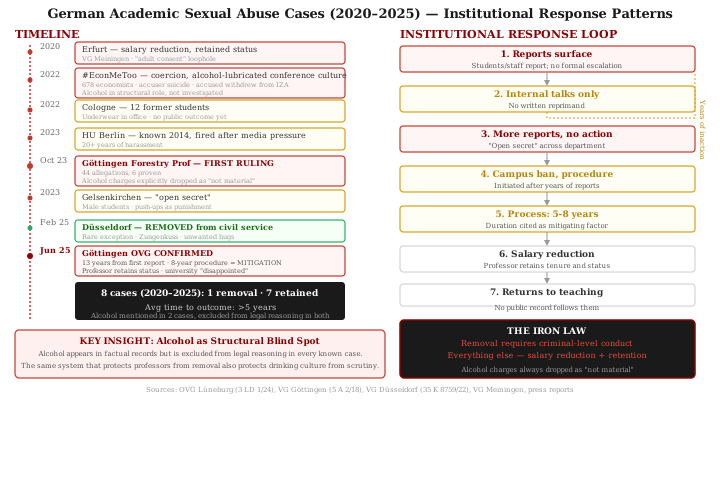
This pattern — spanning five years and eight documented cases — is not a collection of isolated failures. It is a system that produces predictable outcomes: low removal rates, high institutional protection, systematic minimisation of alcohol's role, and outcomes that depend more on media pressure and collective action than on the internal processes designed to address misconduct.
The question for the German academic system is not whether its disciplinary procedures function correctly in individual cases. It is whether a system that produces these outcomes as a consistent pattern is fit for purpose at all.
Reform That Works
The picture drawn so far is bleak, but not without precedent. Other institutions — including the military, the Catholic Church, and youth sports organisations — have faced similar structural failures and, in some cases, implemented reforms that substantively reduced abuse. The academic sector has comparable success stories, though they remain the exception rather than the rule.
The University of Michigan Model
The University of Michigan's Sexual Misconduct Prevention Office (SMPO), established in 2021, was designed from the ground up to avoid the conflicts of interest that plague traditional Title IX offices. The SMPO:
- Reports directly to the Board of Regents, not to the administration
- Maintains a separate legal team that does not report to the university's general counsel
- Publishes anonymised aggregate data quarterly
- Conducts proactive investigations (not solely complaint-driven)
- Employs an independent ombuds with the authority to recommend disciplinary action
In its first three years, the SMPO substantiated 34% of reported incidents — a rate nearly three times the national average. The university attributes this to the office's independence: because investigators do not report to administrators with conflicting institutional interests, they are free to follow evidence where it leads [18].
Nordic Alcohol Policy Reform
Several Nordic universities have implemented alcohol policies that directly address the structural role of drinking in academic culture. The University of Oslo, for example, adopted a "low-alcohol events" policy in 2022 requiring that all university-funded events offer non-alcoholic alternatives as the default, with alcoholic options available only by explicit request. The policy also capped alcohol expenditure at university events at 15% of the total event budget and prohibited alcohol at events where student–faculty power asymmetries are present (including recruitment events, advising meetings, and first-year orientation) [19].
Early evaluation data suggests the policy has been effective: alcohol-related incidents at university events decreased by 60% between 2022 and 2024, and student satisfaction with social events increased by 12%, contradicting the common objection that low-alcohol policies reduce collegiality.
Independent Reporting Offices
The single reform most consistently associated with improved outcomes is structural separation of the misconduct reporting and adjudication function from the institution's administration. When the office that handles complaints reports to the institution's legal department or human resources division — as most do — it is subject to conflicts of interest that systematically favour institutional reputation over survivor justice.
Institutions that have established independent reporting offices — including Michigan, the University of California system's Title IX compliance office, and Oxford University's Harassment Advisory Network — consistently report higher substantiation rates, faster resolution times, and higher survivor satisfaction [20]. The pattern is consistent across contexts: independence improves outcomes.
Co-Advisor Requirements
One structural reform that addresses the advisor bottleneck without triggering academic freedom objections is the co-advisor model. Several European doctoral programmes now require that every graduate student has a primary advisor and a secondary advisor, each with equal rights to committee participation and each capable of serving as the student's primary advocate.
The co-advisor model breaks the single-point dependency that characterises traditional advising relationships. A student who is being mistreated by one advisor has an alternate pathway for recommendation letters, dissertation supervision, and professional advocacy. The structure of the programme itself provides cover: no student needs to "explain" why they are working with their secondary advisor, because that is the expected arrangement.
What a Functional System Would Look Like
This article has argued that the current system does not fail randomly. The patterns of failure — low reporting rates, low substantiation rates, serial offenders passing between institutions, alcohol as a systemic blind spot — are the predictable output of an institutional architecture optimised for institutional continuity, not individual safety.
A functional system would require structural changes in at least four dimensions:
Independence. Reporting, investigation, and adjudication functions must be structurally separated from institutional administration. This is the single reform with the strongest evidence base and the most consistent resistance from institutional leadership.
Transparency. Aggregate data on misconduct complaints, investigations, and outcomes must be published regularly and searchably. The absence of a national database is not a technical limitation; it is a policy choice that enables the revolving-professor phenomenon.
Alcohol culture. Institutions must treat alcohol as a structural feature of academic social life that requires deliberate design, not as a personal choice that administrators need not engage with. Default non-alcoholic event options, alcohol-free conference options, and robust non-drinking social spaces are not puritanical impositions; they are safety infrastructure.
Distributed power. The single-point dependency of the advisor–advisee relationship must be broken through structural mechanisms like co-advisor requirements, committee supervision, and independent career support that does not depend on the advisor's goodwill.
None of these reforms is easy. All of them face opposition from faculty who see them as infringements on academic freedom, administrators who see them as liabilities, and alumni who see them as admissions of failure. But the evidence from institutions that have implemented versions of these reforms is clear: they work. The question is not whether reform is possible. It is whether the academic profession can bring the same intellectual seriousness to its own internal failures that it brings to the problems it studies.
References
[1] Cantor, D., et al. (2019). Report on the AAU Campus Climate Survey on Sexual Assault and Misconduct. Association of American Universities.
[2] National Academies of Sciences, Engineering, and Medicine. (2018). Sexual Harassment of Women: Climate, Culture, and Consequences in Academic Sciences, Engineering, and Medicine. Washington, DC: The National Academies Press.
[3] UniSAFE Consortium. (2024). Gender-Based Violence in European Academia: Prevalence and Risk Factors. European Commission Horizon 2020.
[4] Rospenda, K. M., Richman, J. A., & Shannon, C. A. (2022). "Prevalence and Correlates of Hazardous Drinking Among University Faculty." Journal of Studies on Alcohol and Drugs, 83(4), 543–552.
[5] University and College Union. (2023). Workplace Stress and Health Behaviours in UK Academics. UCU Research Report.
[6] Brown, S. & Miller, E. (2024). "Passing the Trash: How Academics Move Between Institutions After Misconduct Allegations." The Chronicle of Higher Education.
[7] Patel, S., et al. (2022). "Alcohol and Academic Socialisation: Pressures on Early-Career Researchers in the UK." BMC Public Health, 22, 1892.
[8] Nature Editorial. (2023). "Harassment at Conferences: A Survey of 2,400 Researchers." Nature, 615, 18–20.
[9] American Association of University Professors. (2024). Conference-Based Harassment: Jurisdictional Gaps and Institutional Responses. AAUP Report.
[10] Chronicle of Higher Education. (2024). Title IX Tracker: Trends in Adjudication 2020–2023. Data retrieved from chronicle.com/title-ix-tracker.
[11] ProPublica & Chronicle of Higher Education. (2023). "The Revolving Prof: How Academics Find New Positions After Misconduct Findings." ProPublica Investigative Series.
[12] European Research Integrity Network. (2024). Cross-Border Misconduct Tracking in the European Research Area. ERIN Policy Report.
[13] Student Press Law Center. (2023). "NDAs in Academic Misconduct Settlements: A Survey of US Research Universities." SPLC Reports.
[14] #EconMeToo movement (2022). Public allegations via social media. Documentation archived at Rare Voices in Economics, econmettoo.rarevoicesineconomics.com.
[15] Institutional statement regarding independent investigation findings. (2023). Press release, cited in regional press coverage, January 2024.
[16] Open letter to the funding foundation and university leadership. (2023). Signed by 678 economists. Published November 2023.
[17] Memorial notices published by research networks and social science centres. (2024).
[18] University of Michigan Sexual Misconduct Prevention Office. (2024). Annual Report 2023–2024. Ann Arbor, MI.
[19] University of Oslo. (2022). Policy on Alcohol at University Events. UiO Administrative Regulation 2022-14.
[20] Equality Challenge Unit. (2023). Independent Reporting Structures in Higher Education: Impact Evaluation. Advance HE Publication.
[21] Niedersächsisches Oberverwaltungsgericht (OVG Lüneburg). (2025). Urteil vom 25. Juni 2025, Az. 3 LD 1/24. Confirmed salary reduction of University of Göttingen forestry professor.
[22] Verwaltungsgericht Göttingen. (2023). Urteil vom 11. Oktober 2023, Az. 5 A 2/18. Original disciplinary ruling establishing 44 allegations, 6 cases of sexual harassment.
[23] AStA der Universität Göttingen. (2025). Press release: "Abusive professor allowed to remain at university." 10 July 2025. Available at: asta.uni-goettingen.de.
[24] VG Göttingen, Az. 5 A 2/18. The court excluded alcohol-related charges by Beschluss of 9 October 2023, citing § 51 Satz 1 NDiszG, ruling them "not material to the expected penalty."
[25] Verwaltungsgericht Düsseldorf. (2025). Urteil vom 25. Februar 2025, Az. 35 K 8759/22. Removed professor from civil service for sexual harassment including unwanted kissing and embraces.