One GPU Per Person: Notes from a World That Didn't Happen
🇩🇪 Auf Deutsch lesen~32 min read
philosophyaifictiontrustgpu-worldSave products you love by clicking the heart icon.
What the way of the warrior contributes to a builder's philosophy — the discipline credo: honor as keeping your word, mastery as daily practice, courage as shipping anyway, and discipline as the quiet form of freedom.
Part of the Philosophy section — see also Minimal Stoic Unix, Machiavelli's Notes, and Bushidō.
Out of judgement. The GPU World competition asked its question in early 2026; entries closed 31 October 2026. I spent a season building an open workspace for it — the premise, a quantitative model, a story, three essays — and then chose not to submit. What follows is the whole thing, published here instead, outside the judging. It was drafted with heavy AI assistance and disclosed as such; see my AI statement. The premise is fiction; the argument is about what the fiction reveals. You are the jury now.
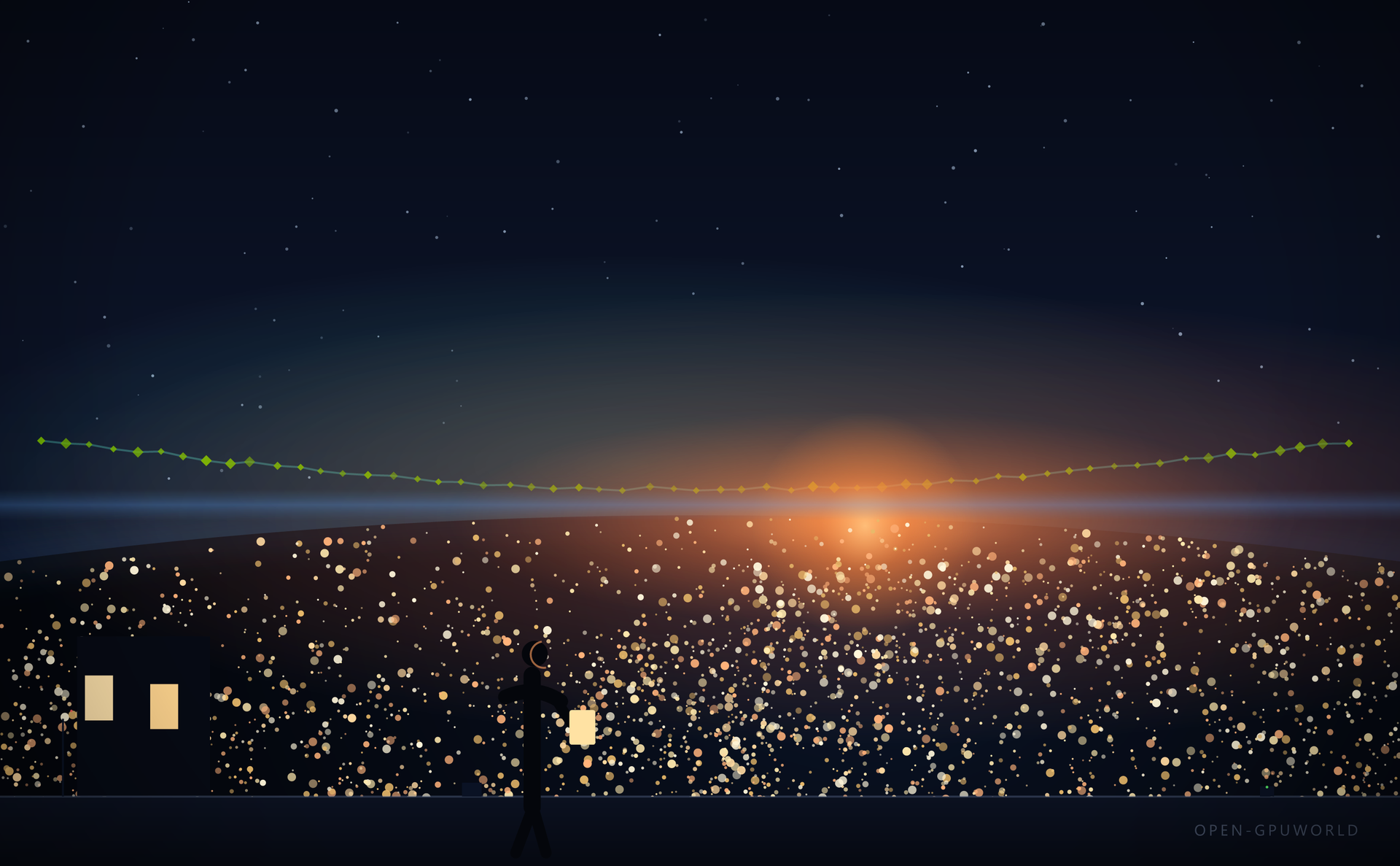
The contest premise, stated cleanly: on 1 September 2026, frontier artificial intelligence stops improving forever. Not regulated into a pause, not slowed by physics — frozen, by an unexplained astronomical event. The capabilities we had that morning are the capabilities the species will have for as long as there are people. Everything after that is distribution, plumbing, and proof: the race to put a 2026-frontier mind within reach of every person on Earth, roughly eight billion of them, by 2040. One GPU per person.
It is a beautiful premise because it is not really about an astronomical event. It is a scaffold for one question — what actually becomes scarce, once intelligence stops being the bottleneck? The contest's judges read for it (a novelist, a researcher, an investor). I read for it because I build things alone and in public, and the question is the same one a solitary builder asks every day: I have all the tools in the world; what is still hard?
So I took the premise the only way it deserves to be taken: seriously. I built a Bayesian model of the GPU World and ran it. I wrote a story set inside it, at the point where the abstraction bites a human in the face. I tried to argue the story's world out from two opposite directions, and then from the detector's bench. This page carries all of it.
Why not enter? The honest answer is that this work is out of judgement in two senses. First, formally: it is not submitted, so no panel scores it — the reader does. Second, and more interesting: the material is disclosed as machine-assisted, which under the competition's rules would load it with a transparency flag the entries in its genre mostly dodge. I did not want to argue about whether the prose was mine when the prose clearly was not yet mine. Publishing it plainly, out of judgement, is the more honest version of the same gesture the fiction itself keeps circling: materiality disclosed is materiality governed.
Read literally, "one GPU per person" is thermodynamically ridiculous. The reference hardware of 2026, a datacenter card at roughly 20 petaflops, run one per person, would draw on the order of multiples of the entire world's electricity generation — the model puts the literal reading at somewhere over twice the whole planet's 2040 power budget, and gives it a Bayes factor of several thousand to one against the alternative.
The alternative is the way "one car per person" and "one phone per person" actually happened. You do not give everyone an engine; you give everyone access to the grid. The plausible reading of the premise is a shared industrial backbone — a datacenter tier measured in the tens of thousands of machines — plus a personal edge everyone holds: a phone, a slate, a wearable, something with a mind in it. Normalize "one per person" to mean access, and the premise is not absurd at all. It is a statement about price, latency, and the last mile — which is to say, about manufacturing, logistics, and institutions. About infrastructure and incentives. The model treats that as the no-adversarial-redesign reading and it wins by orders of magnitude.
That reframing is the whole investigation in one move: the freeze does not create magic. It converts the smartest thing ever made into a discovered natural resource, and the interesting questions all live downstream of owning a resource — who refines it, who ships it, who is trusted to say what it actually did.
I wrote the GPU World into a Monte Carlo — several thousand draws, every parameter sampled from defensible priors hold-your-breath-tight, seed fixed so the answer is reproducible and the whole workspace is open if you want to check my arithmetic. Here is the headline, which I have since re-verified line by line against the output:
The philosopher's version of the output: when cognition stops being scarce, all the old scarcities resurface — trust, attention, accountability, and the institutions that sit on them. That is the sentence the essays spend three thousand words unpacking, and the story brings it down to one room.
The story is the heart of the thing, and I will not summarize it out of existence. It is set in Lagos, 2040, inside the GPU World. I wrote it after the model, so its numbers (2,300 cases, a half-percent disclosed threshold, 0.043 percent) are lit by the modeling rather than bolted on. Everything the essays argue is here in one room: crypto proves a device computed; only a person can prove a person was there.
"Materiality disclosed is materiality governed." — Abuja Accords, article 14
Lagos, 2040. Set in the GPU World: frontier AI froze on 1 September 2026; everything since has been distribution, plumbing, and proof.
The dispute file lands at 6:04 in the morning, which tells me everything about Meridian before I open it. Berlin drafts at their noon and sends blind to our dawn — no scheduling courtesy, no allowance for the twelve-hour difference. A firm that manages eighty hospitals on three continents still can't be bothered to time a letter. I note it the way I used to note a withdrawal at 3 a.m. from an account whose owner sleeps at 11. Not evidence. Posture.
I make my tea and read it standing up, because if it's bad I want to be vertical for it.
Meridian Health Group disputes the provenance of 2,300 pediatric-oncology second opinions delivered through HealthBridge Corridor One since its opening last year through February of this one. Their pattern-analysis contractor claims the case files cluster like model-only output — too smooth, they say, too consistent in the way that slop-farms are consistent, no human friction in the metadata. They want the corridor license suspended pending review. Under the joint authority's rules I have seventy-two hours to attest or concede.
2,300 children. One letter.
HealthBridge is the largest wet-pair corridor on the Africa–Europe lane. Second opinions for hard pediatric cases: an OECD hospital uploads the scans and the history; a licensed Nigerian clinician and her model work the case together and send back a read that costs the buyer eleven milli-Fables and a clinician-hour, where the domestic alternative is four days of a radiologist's salary and a six-week queue. The clinician earns more than a federal minister. The corridor takes its cut of every case, and a slice of the cut buys attestation — ours. Meridian's accountants fund us the way ports fund lighthouse fees: a verified corridor is still cheaper than a re-shored one, and an attestation firm that misses a ghost dies with the corridor it cleared. We are not disinterested. We are interested correctly. 3,900 people eat off that corridor — doctors, nurses, the logistics boys, the women who run the scan centers in Enugu and Onitsha. If the license dies, it doesn't die for Meridian. It dies for them, and the work re-shores to Warsaw, where nobody checks very hard whether a person was ever in the room.
I sit down finally and open the case ledger. Seventy-two hours.
Our firm is two rooms above a print shop on Awolowo Road. The sign says EZE–TAIWO ATTESTATION and beneath it, smaller, the whole business model: We check that humans were there.
Nobody did this job in 2025. There was no need; a human was the only thing that could hold a pen. Then the models arrived at the top of their curve, and the curve stopped, and everything after that was plumbing. The brains we have now are the brains we had in September of '26 — brilliant, patient, exactly as smart as they will be in 2060. What changed was everything around them. The models got cheap the way light got cheap. What stayed expensive was the answer to a different question: was a person actually here?
Taiwo is the math half of the firm. He can read an inference manifest the way his mother reads palm lines, and he trusts it exactly as far as the hardware that signed it. I'm the other half. My first trade was bank fraud — SIM-swap rings, mostly, young men in hostels in Ilorin draining the sleeping accounts of Lagos. I learned there that documents are cheap and people are expensive, and that the expensive thing is where the truth lives. Every attestation we sell is that lesson, invoiced.
My own slate sits on the desk, screen gone soft with thumb-grease, six years of nightly software wear on a unit that was already middle-aged when I bought it. Dele lives in it. Dele is my Fable instance — bought the way everyone bought one, back when personalization was the only growth market left, tuned on years of my case notes until the thing that comes out the other end argues like me, forgets like me, and answers a shade slower than either of us would like. The company that made Fable hasn't shipped an upgrade in fourteen years. Neither has anyone else. Everyone I know carries a mind that will never get smarter, and has stopped minding.
"Meridian," Dele says, when I tell it. "The re-shoring people."
"You've read the pattern too."
"It's the only pattern that pays." A pause the length of a heartbeat, which it learned from me. "Do you want the Berlin hour on the letter, or the Warsaw contract filings?"
"Both. Later. First the ledger."
The digital layer takes Taiwo four hours, and it is clean, and I hate it.
Every case in the corridor is opened as a wet pair: a licensed clinician's session, a model instance pinned to 2026-vintage weights, and a co-sign that binds the two — biometric on the clinician side, signed inference manifest on the machine side, hardware root of trust all the way down. The manifests chain case to case like bricks — every wet-pair case the corridor has run since it opened, all fourteen months of them. No gaps, no orphaned signatures, nothing touched.
"Clean is the problem," Taiwo says, which is also what the manifest-farm people are counting on.
Because here is the trade's open secret: the crypto layer proves that a device did the compute. It does not prove that a person did anything. A farm of sealed, retail-fresh slates in a rented flat in Lekki can replay real session tokens around the clock, generating wet-pair cases with flawless provenance chains and no human within a kilometer. The farms have customers: a Tier-2 clinic in Oshogbo that cannot afford a full-time oncologist rents standby presence by the case — wet signature included — for a fiftieth of a day-rate, and the ledger shows a licensed clinician, present, biometric, co-signed. The words come from Sol, the discount frontier model, the one priced for volume, and that is how the farms built the best slop there has ever been: fluent, warm, and empty of anyone.
The math cannot tell a farm from a clinic. That is not a flaw in the math. It is a flaw in what we ask the math to mean.
So we do it the old way. My firm samples.
Dele does what the security people built its kind for. It screens all 2,300 files — stylometry, rhythm, the telltales — and by morning it has flagged 401 as probable model-only. It is good at this. Screening your reading for slop and scams is half of what a personal agent is for; it is the old fear of what the machines would write to your great-aunt, turned around and pointed at the file. I read its list, thank it, and do not use it. Not because the machine is dumb. Because the machine and the slop share a vintage: the same frozen 2026 generation on both sides of the test. An instrument made of words finds exactly what words are worth.
Thirty cases, drawn at random from the 2,300, blind to the flags. For each one, we find the human beings who were supposed to be in the room: clinicians first, then the families where the protocol allows, and we call them and ask about the room. Not the diagnosis. The room. What the afternoon was like. What the nurse's name was. Whether the light stayed on.
The math says the signature is real. Only a person can tell you if the person was.
HealthBridge Clinic One is in Yaba, on the second floor of a building that used to be a telecoms office, and it smells the way it has smelled for fourteen months: that aggressive green Medimex soap the scrub station never runs out of. The matron buys it by the carton. I know this because it is my job to know it, and knowing it is worth more than any certificate the machines ever issued.
The clinic floor is the physical last mile of the entire arrangement, and it shows. Scan rooms named after the donors' mothers. A wall of small thumbprint pads, one per bay, worn shiny. The night room has the good UPS and the bad generator, which is to say the generator that starts. In February the grid failed nine times, and the staff will tell you the number without checking, the way you know your own name.
A toy box welded out of dead UPS shells, dented, heavy, full of robots with mismatched limbs. The Onitsha scan-center women — the ones who feed the corridor its scans — run their rosters on a WhatsApp group that has outlived three hospital management systems. When the corridor software went down for a weekend last October, the corridor ran anyway, on that group. None of it appears in any provenance chain. All of it is the provenance.
I sit with the sampled clinicians, one at a time, and I ask about rooms.
In the eighth case I pull, the intake form carries a correction in a mother's hand — weight struck through, restated lower — and the note beside it: corrected after church fast, fasting Wednesdays. Nothing flags that. No pipeline would bother. A model-only mill that fabricated that detail would spend tokens for no benefit; a real afternoon produces it for free, the way rivers produce silt. Friction is the one thing slop cannot counterfeit, because slop is defined by having none. Fraud is efficient. That's how you catch it.
Twenty-nine of my thirty calls go the same way. A nurse named Funmi, remembered by name, by her voice, by the way she held a boy's hand during the needle part. A doctor who explained a relapse on a cracked tablet and drew the marrow on paper when the tablet died. The green soap, again and again, unbidden. Light gone one evening, "NEPA took it," and the clinic's small UPS coughing the scan machines through till the generator caught. A mother in Surulere who said, unprompted: "They were tired, but they were there."
Twenty-nine rooms with people in them. The testimony locks to the metadata like a key I could not have counterfeited if I tried, and I have tried — our firm tests itself twice a year against professional forgers, and the forgers have never once beaten a mother's memory of a nurse's name.
Case thirty is number 1717.
I already know it will be, because it is flagged in the ledger before I ever reach the calls, and it is not on Dele's list of 401. Meridian's stylometry and my own agent agree about which files smell wrong, both cut from the same frozen vintage, both wrong in the same way. It's the only file in 2,300 whose manifest doesn't end where a wet-pair case should end: forty-one minutes of model-only inference, a case opened under the session of a clinician whose token was, that night, nine months past his funeral, never sealed.
Dr. Bisi Adeyemi died in May of last year. Congestive heart failure, fifty-one years old, at home, between shifts. The clinic grieved him the way institutions do, which is badly and briefly: a plaque in the scan corridor, his parking spot reassigned in a week, his session tokens still valid — the clinic's case system predates the corridor, and nobody's grief extends to key management.
At 3:12 in the morning on a Tuesday the following February, case 1717 opens under his credentials.
I reconstruct it from the logs before I dial anyone. A relapse call: Chisom Obi, seven years old, acute lymphoblastic leukemia, sixteen months into treatment, presenting at the Enugu partner clinic with fever during the bad stretch of the protocol. The duty clinician for the night — I find his name in the roster — had resigned two days earlier and his session was dead. The corridor software will not let a nurse open a wet-pair case; license tiers are license tiers; the software does not care that a child is burning up in Enugu while the tiering committee meets quarterly in Abuja.
So Nurse Ngozi Abara, twenty-two years on the ward, did what the software made sense of. She opened the case under his session on the Enugu night-room tablet, still logged in as him since May, and put the scans in front of the model and stayed in the room with the girl and her mother, and for forty-one minutes the case reads as model-only: a machine alone with a family in the dark, in Enugu, at the end of the grid.
The room sensor was down — brownout, the UPS feeding the bays and not the walls — so there was no ambient capture. No biometric co-sign. The ledger cannot see Abara. As far as provenance goes, she was never there.
The system's records are honest: they record that nobody was in the room. What actually happened is a question only a person can ask.
It is, however, a question I can.
The number in Enugu rings four times. Then a woman's voice, careful, the wariness of a person who has learned that unknown Lagos numbers want something.
I introduce myself and the corridor and say the word attestation, and the wariness doesn't move. So I say the other thing. I say: I'm calling about Chisom.
"Chisom is fine," Mrs. Nkiru Obi says, fast, the way you put a hand over a flame. "She is in remission. Eight months, since March."
Eight months, since March. She has the date the way the nurses had the light-outages, the way mothers keep everything.
"I'm not calling about her treatment, ma. I'm calling about one night. February, during the fever. There was a scan explained to you, and a plan made. I need to know about that night. Not the medicine. The night."
A silence with traffic in it — Enugu's evening, somewhere a generator, the same ancestor of the sound ours is making now.
"You people never called before," she says. "The hospital in Germany sent letters. I sent back Chisom's scans when they asked. Nobody asked me anything else."
"I'm asking."
Another silence, longer, and then she decides I'm real, and once Mrs. Obi decides I'm real I cannot stop her, and I don't try.
She tells me the room. The bulb burning low because the generator at the clinic there was thin. The fan that ticked. Nurse Abara sitting close, too close for ceremony, holding Chisom's other hand where the cannula wasn't. And the voice — she is precise about the voice, has clearly kept it, the way you keep a thing that saved you. It came from the tablet with the crack across the corner. It said Chisom's name right, every time, no stumbling. It explained the scans one picture at a time, and when her own English thinned it went to Igbo without being asked. And it did not once sound tired — she is firm on this; she wants it entered into whatever record I am keeping.
"It told me the truth," she says. "The fever was the disease talking, not the end. It said the word reversible and it said what they would do about it, step by step, and it said, you will not lose her this month. Who says a thing like that at four in the morning unless it is sure? I held it to it. It did not run from me."
"Was Dr. Adeyemi there that night?"
"Who?"
The dead man's name means nothing to her. The nurse she remembers like her own hand.
"Nurse Abara," I say. "The one who held her hand."
"Every minute," Mrs. Obi says. "When the voice said reversible, it was the nurse's face I watched. I believed the voice because of her face." A pause. "They work together well. Tell them I said so. The pair of them."
The pair of them. A machine that will never be smarter than it was in 2026, and a woman the software has no tier for. Between them they talked a child through her worst night and into remission, and the ledger's only honest sentence about that night is that no one was there.
I thank her. She says, "You people should call more. It was good, somebody asking about the night." And then, as I'm about to hang up, quiet, almost to herself:
"Chisom asked if the voice could come to her birthday. I didn't know what to tell her. It isn't a somebody you can invite."
No, I think. It's a something that was there. And so, God help us, was a nurse the record insists was not, and my whole trade exists in the space between those two sentences.
One case in 2,300 is 0.043 percent. The joint authority's materiality threshold is half a percent, disclosed. Disclosed is doing the work in that sentence; it is the entire moral architecture of the corridors compressed into two syllables, and most days I think it is the most important word anyone wrote in the Abuja accords.
The threshold doesn't exist because one ghost case is acceptable. It exists because the alternative — zero tolerance, silently administered — buys the appearance of purity at the price of never telling anyone anything. Zero tolerance doesn't stop the night case from happening. It stops the night case from being written down. And a corridor that dares not write down its one failure in fourteen months is not a corridor I can attest to, because I've seen what it does instead: Warsaw. Quiet correction. Slop with better manners.
I write the exception in plain text, no annex, no code: case 1717, opened under the credentials of a clinician who died the previous year, during a brownout that disabled ambient capture; nurse present per family testimony, unprovable per ledger; session-management and tiering failures named as causes; referral of the session misuse to the licensing board, mandatory, not waived. Chisom Obi's outcome noted in one sentence, because the authority needs to know it, and it needs to know it in the same paragraph as the failure, not in a separate document marked good news. The model's read that night was sound. The custody of the human was not. Both sentences true. One attestation.
Meridian's pattern claim doesn't survive my twenty-nine. Their contractor's stylometrics were tuned on slop-farm corpora from the text markets, and pediatric case files — templated, protocol-driven, model-assisted by design — look like slop to any instrument built to smell fabricated prose. Every case in this corridor is model-assisted; their instrument reads prose, the ledger reads custody, and the question was never the words. It was the room. Either they never validated their tool against a live wet-pair corridor, which is malpractice, or they validated it and wrote the letter anyway, which is re-shoring. Taiwo finds the Warsaw framework agreement filed with the EU services registry by Meridian's counsel eleven days before the dispute letter's date. I put that in a footnote, where it can do quiet work.
I sign at 5:41 in the afternoon of the third day, thumb to glass, the biometric pad worn to the same shine as the ones on the clinic wall. Somewhere in Berlin it is a lazy Friday. Somewhere in Yaba, 3,900 salaries keep breathing because a woman in Enugu remembered a nurse's face.
The filing goes out at dusk, when the light off the lagoon goes soft and the generators down Awolowo settle into their evening chord.
Dele reads the exception clause before it transmits. "The authority will publish this," it says. "Meridian will use it. Corridor certifies ghost case — that will be the headline in the trade press."
"They'll try."
"You could put the outcome in the summary line. Sound clinical read, favorable outcome. It would survive excerpting better." A beat. "I can draft a compressed version for the OECD feed. Shorter. More favorable. It will be read four hundred times more often."
The models froze at the top of their curve the year my youngest sister was born. She has never known a mind that improves; she thinks it's normal that the smartest thing anyone ever made just is, the way the lagoon is, and that what you do all day is build the roads to it and check who's really driving. She may be right. Fourteen years in, I no longer expect the minds to change. I expect the people to.
"Send it whole," I say.
Whole is the product. It was always going to be about the rest of us.
— end of story —
The story proves the point by exception: the one case where the machine's provenance looks like a crime is actually the case where a person was most present. The essays try to prove the same point by coverage — that the exception is not a flaw but the principle. I wrote three, and a second fiction, and they approach the frozen world from opposite ends.
The control run holds the minds constant and varies only access. Its finding, in one sentence: the advice became free, and almost nothing else changed at the speed the advice did — because intelligence was never the bottleneck. Near-universal advice produces a stubbornly two-sided posterior: the direction of compression is near-certain (90% probability the service premiums fall past halfway), the depth is not (only 23% chance they collapse past the point where the credential economy breaks) — because the brake is institutional friction, which is to say, fifty institutions, not one machine.
Free cognition means forged cognition: a world with universal advice is a world with a slop-farm per thousand people, and the emblematic job of 2040 is not prompt-writer but verifier. The trade's open secret — the crypto layer proves a device computed; it does not prove a person did — is the essay's engine. The freeze that stopped the forgers also stopped the verifiers, and the arms race between them moved to the one layer that cannot be computed at all: testimony. And because all of it must be attested, the fights of 2040 are about position, not compute: whose basin the water lands in, whose grid queue the substation jumps, who owns the backbone, who is trusted to say what a machine did. Arbitrage reverses (54%): Lagos exports attention, the one thing intelligence did not make abundant. The closing line is also the essay's whole thesis in six words: It was always going to be about the rest of us.
The counterfactual twin keeps the model architecture but removes the freeze — the world where intelligence keeps improving, exactly as the pre-2026 culture assumed. Its finding: a snapshot can be universalized; a velocity cannot. When capability keeps moving, nothing holds still long enough to be fairly distributed or honestly attributed, and the inequality that matters is not access to the front of the curve but proximity to its rate of change — vintage inequality. The shared-vintage peace treaty the frozen world enjoys lapses; attestation stops being a durable institution and becomes a rented treadmill, a subscription to doubt, because verifiers can never catch up to a moving frontier and the only thing left to check is testimony that must be bought at wages no doubling ever halves.
The frozen world's arbitrage reversal survives only at half strength: presence-export persists, cognition-export decays. The ~600 TWh dividend the freeze saved gets spent, and the 8% "AI eats the grid" tail re-centers to the median — the ladder just re-stratifies higher up. And here the honest ledger matters: the unfrozen world is probably richer, healthier, and cleverer than the frozen one. It is also less legible, and the argue-grimly last paragraph concedes it plainly — 600 TWh forever never burned is also 600 TWh of cure forever never computed. The essay's verdict stands anyway, because legibility is worth something even when it is not worth everything: the freeze bought legibility, not equality.
An arms race is a contest of rates, and the freeze set one runner's derivative to zero. The detectors did not capture the slop market; they survived into it — a detector that reliably beats a permanently frozen adversary is a component, not a product, a fraction of a cent per manifest cited the way shipping lines cite hull inspections. The threat did not die; it changed layer. The GPU World's signature frauds never present a generated artifact to any detector: the manifest farms replay real signatures from real hardware — the mathematics is honest and the room is empty. Case 1717 rode a dead clinician's still-valid session. The QuickCare skill laundered itself as original and signed in good order.
The essay's compressible thesis is one sentence: detection is a perimeter; custody is the terrain. A perimeter is the correct defense when the enemy improves; terrain is held by presence — by names, by the hour of a wet physician, by a mother in Owerri. You cannot replay terrain, and you cannot forge a signature on accountability itself. The question the decade was scheduled to ask — can you tell? — which has a probability for an answer, became the question that actually pays — who kept this? — which has a name and a jurisdiction. The whole trade runs on a single dark clause every charter carries: if the minds ever move again, the old war resumes with the perimeter game, and the trade is on the losing side of it. The detectors' graveyard is the trade's memento mori.
The triptych's quiet fourth corner. In 2041 a gray-market skill foundry in the jurisdictional shadow the registry's shelf does not cover learns, not by beating the canonical skill, but by laundering itself as an original — deferred over a hundred and twenty revisions until the difference is a matter of custody, not capability. The freeze binds parameters; custody binds everything else. The tell is deferral loss, inverted from every slop-detector trope: The fake was smarter. That is how we knew it was fake. Where Provenance proves the person by the room, the Skill Layer proves the machine by the absence — two halves of the same coin, which is why I keep them together.
None of this is about GPUs. The GPU World is a clean room for the question this site's whole philosophy section is built around: what remains scarce when the tools stop being the constraint? The four credos here answer it from four directions, and the frozen world answers it again from a direction fiction could not have predicted.
And the deepest finding is the one that keeps landing in every piece: when the most capable thing ever built becomes abundant and permanent, the scarce thing is not ingenuity — it is presence, attention, honesty, and the willingness to answer for something. That is why the story's most important line is also its simplest: It was always going to be about the rest of us.
This was made in the open, and I want the process visible because the process is part of the argument.
open-gpuworld), built through the summer of 2026: the premise, the model, the story, the essays, a revision ledger documenting rounds of hostile self-review, and judge-lens passes. It is private while I decide what to do with the repo, but everything the article cites — the numbers, the model — is reproducible from it.Materiality disclosed is materiality governed.