The Banality of Evil: Arendt, Thoughtlessness, and the Machine That Administers
🇩🇪 Auf Deutsch lesen~12 min read
philosophyethicspoliticsaiPart of the Philosophy section — a companion to Words That Do Things and The Tool Vanishes.
Framing: A Short History of Philosophy
In 1961 the Israeli government put Adolf Eichmann on trial in Jerusalem, and a young political philosopher named Hannah Arendt went to watch. She expected to see a monster. What she saw instead was a clerk. A man who spoke in clichés, who could not finish a sentence without reaching for a stock phrase, who described his career in the language of diligence and duty, and who, when asked about the millions he had helped deport and murder, said he had only been following orders and doing his job well. He was not fanatical. He was not even especially anti-Semitic by the standards of his milieu. He was, in a word that Arendt chose and that the world has never quite forgiven her for, banal.
The shock of that word is the shock of the essay. It is not a claim that evil is ordinary, or that everyone is secretly a killer, or that the Holocaust was nothing special. It is a claim about a specific mechanism: that enormous harm can be done by people who are not thinking, and that the absence of thought is not the absence of intelligence. Eichmann was not stupid. He was thoughtless. And thoughtlessness, Arendt argued, is not a moral defect in the usual sense. It is a failure of a particular kind of activity — the activity of judging, of asking whether what one is doing is right — and it flourishes precisely inside well-organized systems.
The banality of evil is not "evil is ordinary." It is "evil can be done without thinking."
That sentence is the lens through which this essay reads the present. A system that decides — a bureaucracy, an algorithm, a platform, a model — does not need a monster at the controls. It needs a person, or a process, who has stopped asking whether the output is right. The question for us is not how to spot the monster. It is how to keep the thinking from leaking out of the system.
Arendt's account of Eichmann rests on a distinction she had been building since The Origins of Totalitarianism (1951). Totalitarianism is not merely tyranny. It is a system in which the normal fabric of human relations is dissolved and replaced by an ideology that explains everything in advance. The individual is not asked to believe — belief requires a self that could doubt. The individual is asked to behave, to perform a role inside a machinery whose purpose is given and whose logic is not to be questioned.
Eichmann was the ideal subject of such a system because he had no inner resistance to it. He was not a true believer in the Nazi ideology; he was something more useful and more frightening. He was an administrator who had made obedience into a virtue and who experienced the machinery not as a moral problem but as a professional challenge. When asked to organize the deportation of Jews, he organized it efficiently. When asked about the deaths, he said the orders had come from above. He never asked whether the orders were right, because asking was not part of his job. His conscience, he said, was clear. He had done his duty.
The word Arendt used for this state was not stupidity but thoughtlessness. She meant something specific: the failure to engage in the internal dialogue between "I" and "me" that constitutes thinking. For Arendt, thinking is not the possession of doctrines or the solving of problems. It is the conversation with oneself that happens when one is alone, the moment when the actor steps back from the role and asks, what am I doing, and can I live with it? Eichmann could not have this conversation. He had replaced it with the language of the system — with clichés, with the vocabulary of the SS, with the self-image of a man who does his job.
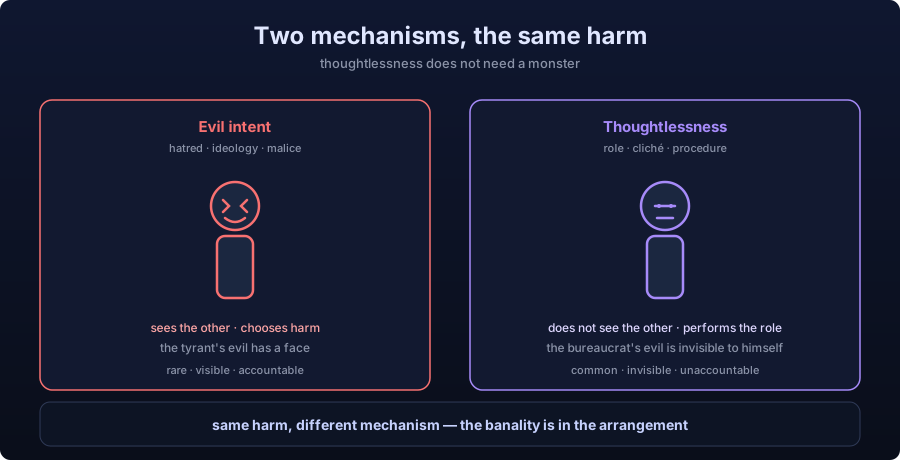 Thoughtlessness vs. evil intent: the monster on one side, the bureaucrat on the other, with the same harm done by different mechanisms
This is the point that is so often misread. Arendt is not saying Eichmann was innocent. She is saying that his guilt was not the guilt of a villain in a story. It was the guilt of a person who had allowed a system to do his thinking for him, and who therefore could not see what he was doing. The evil was real; the mechanism was mundane. That is the banality.
Arendt's most important political insight, and the one with the longest reach, is about what happens when action is replaced by administration. In a traditional tyranny, a person rules: the tyrant decides, and the subjects know who is responsible. The evil has a face. In a modern bureaucracy, and especially in a totalitarian system, nobody rules. Decisions are made by processes, by procedures, by the accumulation of small, rational steps that no individual chose and no individual can stop.
Arendt called this the rule of Nobody — Herrschaft des Niemand. It is the defining condition of modern administration. The person at the desk does not decide the policy. The policy is decided by the system, by the mandate, by the procedure. The person implements. And because no one person decides, no one person is responsible. The harm is real, but the agency is distributed so thinly that it cannot be grasped.
This is the structure she saw in Eichmann, and it is the structure she saw in the modern state more broadly. The banality of evil is the banality of a system in which the individual has become a function. The functionary does not ask whether the function is good, because the function is defined by the system, and the system is not a thing one can ask. The question "is this right?" has no address.
The danger, Arendt warned, is not that the system is malicious. It is that the system is rational. A rational system with no one thinking inside it produces harm that no one intended and no one can stop. The banality is not in the evil. It is in the absence of the thought that would have prevented it.
Arendt spent the last part of her life working on judgment, and it is the key to understanding what she thought thinking was for. In The Human Condition (1958) she distinguished three activities: labor (the biological cycle of survival), work (the making of durable things), and action (the revealing of the self through speech and deed in the presence of others). Action is the highest, because it is where freedom appears. It is also the most fragile, because it depends on a public world in which people can see and be seen.
Judgment is the faculty that action needs. It is not the application of a rule — that is what a machine does. It is the capacity to see a particular situation from multiple standpoints, to imagine what it looks like to others, and to decide what is fitting. Kant's Critique of Judgment was Arendt's model: judgment is not subsumption under a concept but the ability to find the universal in the particular, to say this is exemplary.
The failure of judgment is not the failure to follow a rule. It is the failure to see. Eichmann could not see the Jews he deported as persons, because his role did not require it. He could see them as files, as quotas, as problems to be solved. The inability to see another person as a person — not because of hatred but because of role — is the mechanism Arendt identified. It is why she insisted that the greatest danger to freedom is not the tyrant but the bureaucrat, because the bureaucrat's evil is invisible to himself.
This is the point that makes her work a philosophy rather than a history. She is not saying that Eichmann was unusual. She is saying that the conditions that produced him — a system that rewards performance, a language that replaces thought, a role that absorbs responsibility — are permanent features of modern life. The banality is not in the man. It is in the arrangement.
Arendt died in 1975, but her diagnosis reads like a manual for the present. We have built systems that decide — credit scores, risk assessments, content moderation, parole predictions, hiring filters, fraud detection — and we have staffed them with the same structure she described. The decision is made by a process. The process is rational. The person in the loop implements. And the question "is this right?" has no address, because the address is the algorithm, and the algorithm does not think.
This is not a claim that algorithms are evil. It is a claim about structure. A system that decides without thinking reproduces the exact conditions Arendt warned about: harm done by people who are not malicious, through processes that are rational, in a framework where no one is responsible. The banality of evil was never about Nazis in particular. It was about what happens when a rational system runs and no one is home.
The modern version is more efficient than Eichmann's, because it does not even need a person to be thoughtless. It needs only a person to be absent — to accept the output, to sign off on the decision, to treat the score as a fact rather than a judgment. The thoughtlessness has been automated. The system thinks for you, and the thinking it does is the thinking of the specification, which is to say the thinking of whoever wrote the specification, which is to say no thinking at all, because a specification is not a thought.
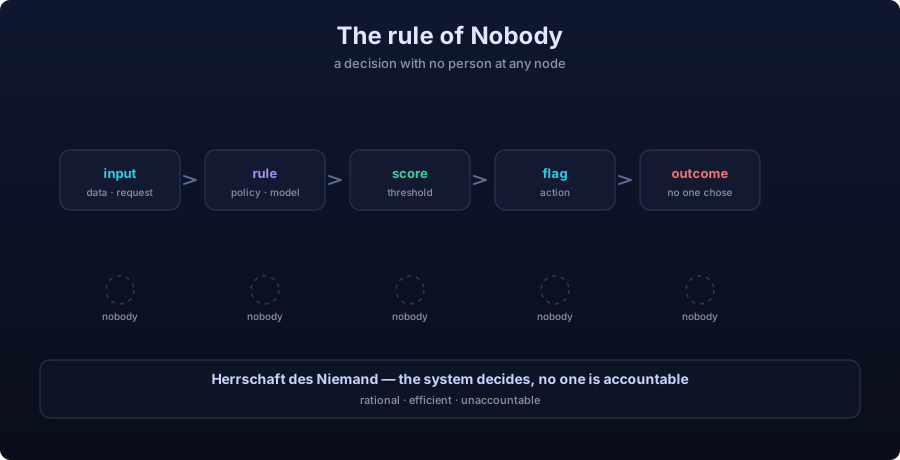 The rule of Nobody: a decision flowing through a chain of nodes with no person at any of them, ending in an outcome no one chose
This is the connection to the tacit-knowledge problem. A system that decides without thinking has no access to the tacit sense of which words matter here, now, for this person. It has only the explicit rule. And the explicit rule, applied without judgment, is the same thing Arendt saw in Eichmann: a performance of correctness that has lost contact with the reality it is supposed to serve. The harm is not in the rule. It is in the absence of the person who would have said, wait, this is wrong.
The conclusion is not "abolish systems." It is to design and inhabit them in a way that keeps the thinking inside.
Put a name on the decision. Every automated decision should have a human owner — not a reviewer who rubber-stamps, but a person who is accountable for the outcome. If you cannot name the person, you have built a system that decides and no one is home.
Make the override real. An override that is technically possible but practically punished is not an override. The person in the loop must have the authority and the incentive to say no. Otherwise the loop is decoration.
Show the work. A decision that cannot be explained cannot be judged. Explanations are not for the user's comfort; they are for the decision-maker's accountability. If the system cannot say why, the person cannot say whether.
Design for the particular. Rules are general; harm is particular. A system that applies a rule without seeing the person in front of it reproduces the bureaucrat's blindness. Build in the moment where someone has to look.
Resist the language of the system. "Risk score", "confidence", "threshold", "flag" — these words replace thought with measurement. Use them, but do not let them do your thinking. The number is not the judgment.
Keep the conversation alive. Arendt's thinking is a conversation with oneself. A system that never pauses, never questions, never asks "is this right?" has no thinking in it. Build in the pause. Build in the question. The pause is where the human lives.
The banality of evil is not a diagnosis of the past. It is a warning about the present. It says that the conditions that produced Eichmann — a system that rewards performance, a language that replaces thought, a role that absorbs responsibility — are permanent, and that they do not require a tyrant to activate. They require only a system that decides and a person who has stopped asking whether the decision is right.
The machine that administers is not evil. It is a tool, and like all tools it withdraws into the work. The danger is not that it decides. The danger is that we let it decide in our place, and that in doing so we become the thing Arendt described: a person who has stopped thinking, inside a system that never started.
The task is the same as it has always been: to remain the kind of people who can tell the difference between a decision that is correct and a decision that is right — and to build systems that leave room for that difference to be noticed.