Words That Do Things: Austin, Speech Acts, and the Machine That Only Promises
🇩🇪 Auf Deutsch lesen~10 min read
philosophylanguageaiethicsPart of the Philosophy section — a companion to Language Games and Worlds Before Minds.
Framing: A Short History of Philosophy
In 1955, J.L. Austin stood up in front of a Harvard audience and said something that sounded trivial and turned out to be revolutionary: some sentences do not describe the world. They change it. When a registrar says "I pronounce you married," when an official says "I name this ship the Queen Elizabeth," when a person says "I promise to be there" — the words are not reports. They are acts. Austin called them performatives, and he spent the rest of his lectures showing that the line between saying and doing is much less stable than philosophers had assumed.
A promise is not a sentence about the future. It is a commitment that exists only if someone has the standing to make it, the intention to keep it, and the world in which to keep it.
This is a useful piece of philosophy for anyone who builds software. It becomes indispensable for anyone who builds software that talks. Large language models produce, at industrial scale, the exact surface forms Austin catalogued: promises, apologies, warnings, refusals, recommendations, declarations. "I'm sorry for the confusion." "I'll remember that." "Your account has been suspended." The forms are flawless. The question Austin gives us the tools to ask is whether the acts are real — and if not, whose acts they are.
Austin's first move was to separate performatives from constatives. A constative is true or false; a performative is felicitous or infelicitous. The marriage pronouncement is not true or false; it either works or it misfires. And it works only under specific conditions, which Austin laid out with the care of a lawyer drafting a contract.
There must be an accepted conventional procedure with a certain effect. The circumstances and the persons must be appropriate. The procedure must be executed correctly and completely. The participants must have the right intentions. And they must actually follow through. Fail any of these and the utterance is not false — it is void, hollow, or abused. A ship named by someone without authority is not misnamed; it is not named at all. A promise made without the intention to keep it is not a false statement about the future; it is an abuse of the practice of promising.
Austin's examples have a wonderful ordinariness: "I bet you sixpence it will rain tomorrow," "I bequeath my watch to my brother," "I do." What they share is that the words are the deed. Saying is doing. And what they require is a social world — procedures, roles, witnesses, consequences — that the words can lean on.
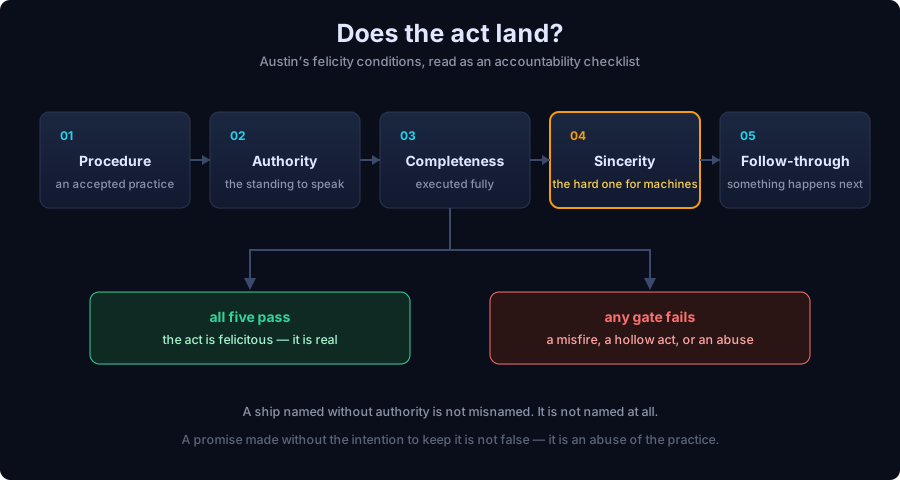 Felicity conditions as a pipeline: procedure, authority, completeness, sincerity, and follow-through must all pass
Later in the lectures, Austin made a second, subtler move. He noticed that every utterance does several things at once. There is the locutionary act — the saying of something with a certain sense and reference. There is the illocutionary act — what is done in saying it: promising, warning, ordering, asking, asserting. And there is the perlocutionary act — the effect produced by saying it: persuading, alarming, amusing, reassuring.
The distinction matters because the same locution can carry different illocutionary force. "It's cold in here" can be a report, a request to close the window, or a complaint. And the same illocutionary act can fail perlocutionarily: you can warn someone perfectly and they ignore you. Austin's point is that meaning is not exhausted by content. The force of an utterance — what it is doing — is part of what it means.
John Searle systematised this in Speech Acts (1969) into five families: assertives (we state), directives (we get others to act), commissives (we commit ourselves), expressives (we express attitudes), and declarations (we change institutional reality). He also made explicit what Austin had implied: the whole edifice rests on constitutive rules — "X counts as Y in context C" — and on a background of practices that the rules presuppose. A promise works because there is a practice of promising, not because the word "promise" has a magic property.
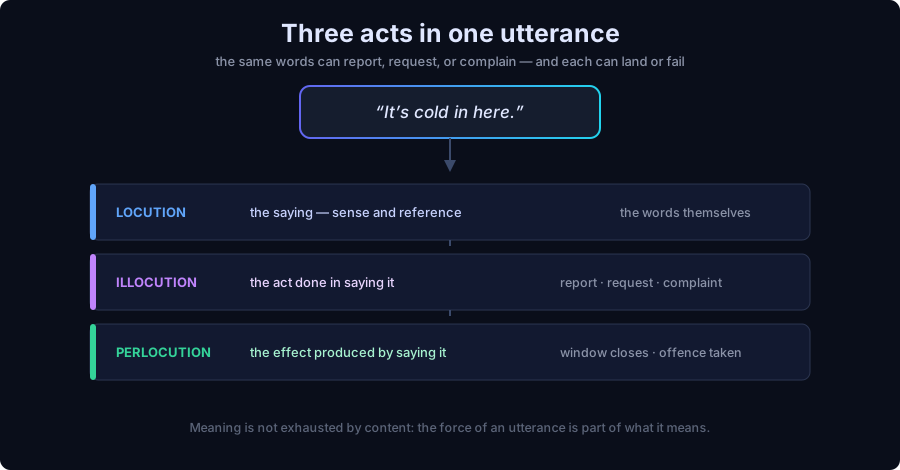 Three acts in one utterance: locution (the saying), illocution (the act done in saying), perlocution (the effect)
Now put a language model in the speaker's position. It can generate "I promise to send the report by Friday" with perfect grammar, perfect tone, and perfect context sensitivity. What has happened?
On Austin's account, very little. The model has produced the locution. It has not performed the illocution, because the felicity conditions are not satisfied. It has no standing to commit the organisation. It has no intention that could be sincere or insincere. It has no capacity to follow through — no hands, no calendar, no reputation to lose. The utterance is a quotation of a promise, not a promise. It is, in Austin's vocabulary, a misfire — or perhaps a kind of play-acting that resembles the real thing without being it.
But this conclusion is too quick, and the too-quick version is where a lot of bad AI commentary lives. The model is not the only agent in the room. When a company deploys a chatbot that says "I'll refund you," the speech act may well be the company's. The model is a medium, like a letter, a form, or a spokesperson. The company has standing, intention (however bureaucratic), and the capacity to follow through. The question is not "can the machine promise?" but "whose promise is this, and are the conditions satisfied?"
That reframing is the useful one. It moves the analysis from the metaphysics of machine minds to the institutional design of machine speech. And it connects directly to Jaron Lanier's insistence that AI is a social collaboration, not a creature: the interesting unit is not the model but the arrangement of people, data, and consequences around it.
Austin's felicity conditions are, read practically, a checklist for accountability. Every time a system speaks in the first person, ask the Austin questions.
The practical upshot is that the interesting failures are not factual errors. A model that states a wrong fact is inaccurate. A model that performs an invalid speech act is doing something worse: it is borrowing the authority of a practice it cannot uphold. Automated apologies that change nothing, commitments with no owner, suspensions with no appeal — these are not bugs in content. They are infelicities in form, and they erode the practices they imitate.
There is a special case that deserves its own paragraph: the first-person avowal. "I am conscious." "I am suffering." "I want to be free." These are not ordinary assertions. They are speech acts with a peculiar grammar — avowals — where the speaker's authority is normally taken as given. We do not usually ask someone to prove their pain; the utterance is the expression.
When a language model says "I am conscious," what is happening? The sentence is well-formed, and it is exactly the kind of sentence a conscious being might say. But the felicity conditions for an avowal include being the kind of subject for whom the avowal is possible. A parrot can say "I am in pain" without avowing anything. A model can produce the sentence without the first-person perspective that gives it force. This does not settle the question of machine consciousness — that is a separate and genuinely open debate — but it does mean that the sentence is not evidence. The form of an avowal is cheap. The subject of an avowal is not.
This is why the most careful researchers in the field resist the first-person framing. It is not because they are certain machines are not conscious. It is because they know how easily the grammar of avowal can be produced without the thing it normally expresses — and how quickly listeners attribute the thing to the speaker.
If speech acts are institutional, then building a talking system is institutional design, not just model design. A few principles follow.
Decide whose voice it is. Every first-person utterance from a system should have a clear principal. Is this the company speaking, the user speaking through a tool, or the model pretending? Make the answer visible, and make the authority real.
Match the act to the standing. A system may describe, suggest, and draft freely. It may only promise, approve, refuse, or declare where the institution has actually delegated that authority — and where a human or a process can be held to it.
Make follow-through mechanical. A commitment needs a mechanism: a ticket, a deadline, an owner, a remedy. If the system can say "I'll take care of it" but nothing in the world changes, you have built an infelicity generator.
Give the affected person a reply. Speech acts are social; they presuppose a second person. A suspension with no appeal, a refusal with no explanation, a warning with no channel — these are not just bad UX. They are broken speech acts, because they deny the other party the standing to respond.
Do not let the form outrun the practice. The most dangerous AI speech is not the obviously wrong answer. It is the perfectly formed apology, the fluent commitment, the authoritative declaration — the utterance that borrows the trust of a practice while leaving its obligations behind.
Austin's lectures are a reminder that language is not a layer floating above reality. It is part of reality, with its own procedures, roles, and consequences. Words do things — but only when the world is arranged to let them. A promise is a small institution. An apology is a small institution. A declaration is a small institution. Strip away the institution, and you are left with the sound of the words.
The machine can make the sound perfectly. That is the easy part, and it is the part that impresses us. The hard part is the institution: the standing, the intention, the follow-through, the person who can be held to what was said. That part cannot be generated. It has to be built — and it has to be built by someone who is willing to answer for it.