Know Thyself: γνῶθι σεαυτόν, from Delphi to the Machine That Cannot Obey
🇩🇪 Auf Deutsch lesen~7 min read
philosophyclassicsaidelphisocratesself-knowledgemetacognitioncalibrationobservability
Kant asked four questions — What can I know? What ought I to do? What may I hope? What is the human being? — and answered the second with the categorical imperative. Two centuries later the questions are sharper than ever: they collide with recommendation engines, delegated judgment, and black-box models. What survives of the imperative when the agent is partly a machine?
Part of the Philosophy section.
Before it was a slogan on gym bags and therapy Instagram, γνῶθι σεαυτόν was two words carved into a stone column at the entrance of Apollo's temple at Delphi — alongside μηδὲν ἄγαν (nothing in excess) and ἐγγύα πάρα δ' ἄτη (a pledge brings ruin). Pausanias, who saw the column standing in the second century, reports the attribution was already disputed: some gave it to Chilon of Sparta, some to the Seven Sages collectively, some to Apollo himself. It does not matter much. What matters is what a command like that was for — and that we have quietly replaced its meaning with a softer one.
You are going to want to say this out loud at least once. The classical Attic pronunciation, as best we reconstruct it:
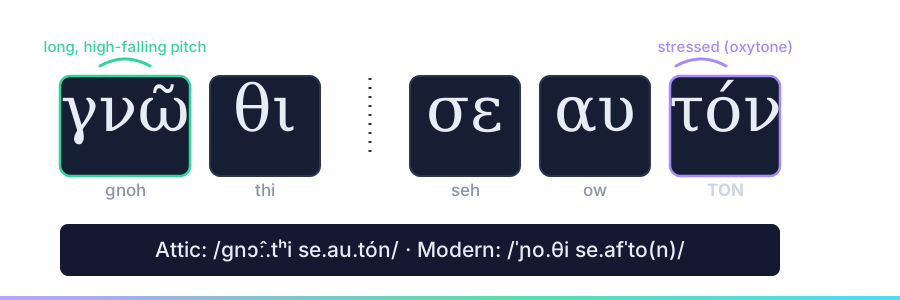 Syllable breakdown: γνῶ·θι σε·αυ·τόν with stress on the final syllable of σεαυτόν
The grammar is part of the meaning, and it is sharper than the translation. Γνῶθι is the aorist imperative of γιγνώσκω, to know — the aspect of a single, decisive, completed act. Not the present imperative γίνωσκε (keep on knowing), which would make self-knowledge a continuous practice, a habit. The stone commands a punctual act: know yourself — once, now, decisively. And σεαυτόν is the accusative of the reflexive: not your nature as an object of study, but yourself as the thing you drag around with you whether you study it or not.
The comfortable reading — introspect, find your authentic self, follow your bliss — is a nineteenth-century heirloom with a Greek label glued on. At Delphi the maxim meant something harder and colder. You came to the temple to ask a god questions, and the first thing carved in the stone on your way in was: remember what you are. Not: you are wonderful. Rather: you are mortal, limited, and about to receive an answer from something that is neither.
Three readings, in ascending order of ambition:
Heraclitus, a century earlier, had already compressed the whole practice into a fragment: ἐδιζησάμην ἐμεωυτόν — I went in search of myself. Note the verb. Not I contemplated, not I meditated on. I searched. The self is not a room you sit in; it is terrain you cross.
Here is why an infrastructure engineer keeps writing about a dead sanctuary. Every operational discipline we have — observability, monitoring, post-mortems — is the Delphic maxim with a Grafana dashboard bolted on. Know thy system: its limits, its failure modes, the boundary between what it does and what you merely believe it does. We accept without embarrassment that a distributed system needs external instruments to know itself, because introspection from inside the running process is famously unreliable.
Large language models are the first artifacts that fail the maxim in a recognisably human way. A model that hallucinates a citation is not lying; it is producing fluent output in a region where it has no knowledge, without marking the boundary. The technical name for the missing property is calibration: does the system's stated confidence track its actual error rate? A well-calibrated model that says I am 70% sure is right seven times out of ten. Calibration is nothing but the Apology rendered in numbers — an accurate inventory of the border between knowing and not-knowing — and its failure mode has the same shape as ours. Psychology found the human version in 1999: the Dunning–Kruger effect, where the least skilled are also the least able to know that they are. An uncalibrated model is Dunning–Kruger at industrial scale.
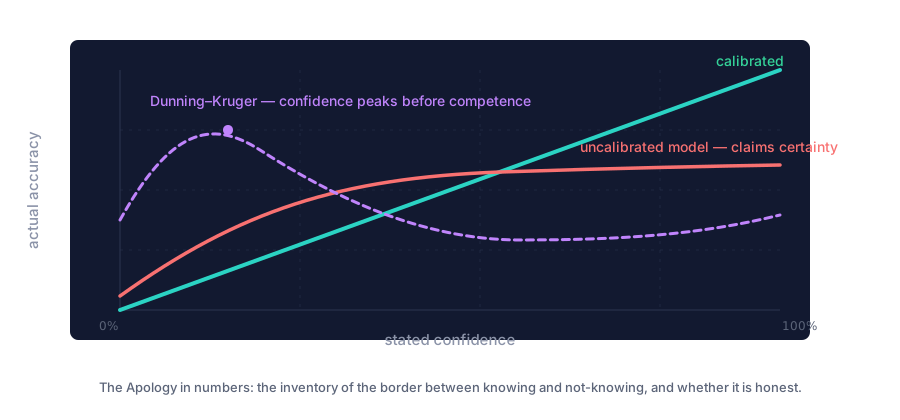 Calibration diagram: stated confidence versus actual accuracy — the calibrated diagonal, the overconfident model, and the Dunning–Kruger curve
There is even a mirror in the mirror. Gallup's mirror test — does an animal recognise the reflection as itself — is administered to organisms; the machine version asks whether a system can build a model of its own operation that has predictive power. Self-knowledge, in both cases, is not mystical. It is a map of yourself that predicts your own behaviour, including your errors. That is all Socrates was claiming, and it is all a monitoring stack delivers.
But a reflection has a property the thing itself lacks: you can rotate forever and never land on it. Mathematics calls an object that cannot be brought into coincidence with its mirror image by any rotation chiral — handed. A left hand is chiral. A trefoil knot is chiral. Tie a knot in yourself, and you become the kind of thing that can only ever meet its reflection back-to-back:
The maxim survives because it is not advice but a boundary condition. Every generation rediscovers that the self — human or silicon — is the one system whose interior is not automatically available to itself, and that the difference between competence and disaster is usually the accuracy of the inventory.
The command has a coda twenty-four centuries long. Pindar, a generation before Socrates: become such as you are, having learned what that is. Montaigne, in the tower of his library, keeping the most honest notebook ever written on the grounds that every man bears the entire form of the human condition — and finding, page after page, not an essence but a weather system. Nietzsche, who read Delphi harder than anyone, replaces the imperative in The Gay Science: what does your conscience say? — you shall become the one you are. Know thyself stops being an endpoint and becomes a release condition: you cannot become what you are until you have an accurate account of what that is.
That is the honest final state of the maxim, and it is the same for the machines. Self-knowledge is not a state you reach; it is a calibration you maintain — against the oracle, against the mirror, against the dashboard, against the next hard question from someone younger than you. The stone at Delphi did not promise you could do it. It just refused to let you in without trying.