Electric Guitar, Part 1: Body Shapes, Pickups, and the Amp Chain
🇩🇪 Auf Deutsch lesen~12 min read
MusicTheoryguitarelectric-guitarfendergibsonbody-shapespickupamplifiermusic
Comprehensive guide to jazz improvisation covering ii-V-I progressions, rhythm changes, modal jazz, transcription methodology, practice strategies, and essential listening across jazz history.
Essential music theory concepts for electronic music producers covering scales, chords, progressions, rhythm, basslines, and melodic writing — with practical applications for modern production.
The electric guitar reshaped 20th-century music. From country twang to rock distortion, from jazz chords to metal shred, it became the defining instrument of modern popular music.
This is a series now, because one page tried to hold everything and became a wall:
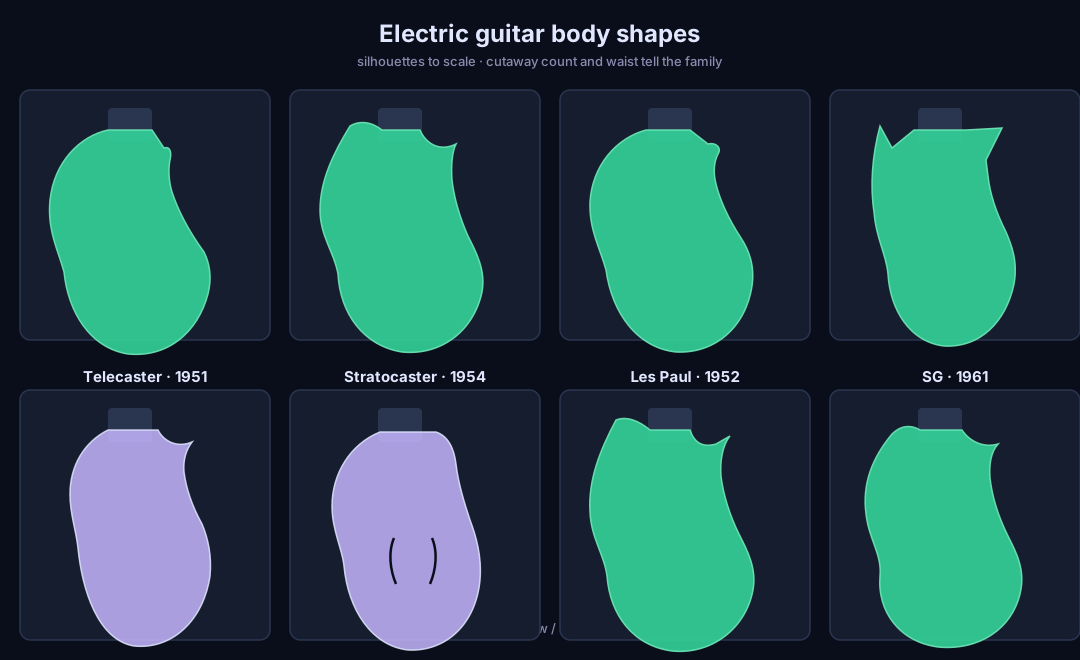 The eight most influential electric guitar body shapes compared: the Big Four solidbodies plus semi-hollow, archtop, superstrat and offset designs
Four electric guitars shaped modern music: Fender Telecaster (1951), Fender Stratocaster (1954), Gibson Les Paul (1952), and Gibson SG (1961). Each introduced innovations that became industry standards.
Leo Fender introduced the Telecaster (originally the "Broadcaster") in 1951 as the first mass-produced solid-body electric guitar. Its design was revolutionary for its simplicity and durability.
Construction: Bolt-on maple neck (25.5" scale), ash or alder body, single-cutaway flat design. The bridge and bridge pickup form one integrated unit mounted on a metal plate. This modular design meant necks could be replaced by screwing - no complex luthiery required.
Electronics: Two single-coil pickups, master volume, master tone, three-way switch (originally bridge/neck+bridge/neck; changed in 1952 to bridge/neck/bassier neck). The bridge pickup produces a bright, cutting tone with a thick midrange that made the Telecaster a favorite in country and rock.
Historical impact: The Telecaster fueled early rock-and-roll, surf music, and the "Bakersfield sound" pioneered by Buck Owens. Keith Richards' "Micawber" - a modified 1953 Telecaster with a reversed PAF humbucking pickup at the bridge and a five-string open-G tuning - became one of rock's most iconic guitars.
Variants: Thinline Telecaster (1968, semi-hollow), Telecaster Custom (1972, humbucker at neck), Telecaster Deluxe (1973, dual humbuckers, Strat-style headstock). The B-Bender modification (invented by Gene Parsons and Clarence White in 1967) mechanically bends the B string up a whole step for country pedal-steel effects.
The Stratocaster introduced features that would become electric guitar standards: three pickups, a contoured body for ergonomics, and a spring-loaded tremolo system.
Construction: Bolt-on maple neck (25.5" scale), alder or ash body with deep contours on the back and front for comfort, double-cutaway. The headstock is larger than the Telecaster's, which some players argue provides more sustain.
Electronics: Three single-coil pickups with a five-way selector (three-way until 1977; players discovered in-between positions produced hum-cancelling pairs). Master volume, tone 1 (affects neck/middle), tone 2 (affects bridge). The reverse-wound, reverse-polarity (RWRP) middle pickup creates hum-cancelling when combined with neck or bridge.
Tremolo system: Six-screw bridge balanced by springs in a rear cavity, allowing pitch modulation via the "whammy bar." Though marketed as "tremolo" (volume variation), it's actually vibrato (pitch variation). The floating design allows raising and lowering pitch; players like Jimi Hendrix, Jeff Beck, and Ike Turner exploited this extensively.
Historical impact: The Stratocaster became the guitar of choice for rock virtuosos: Jimi Hendrix, David Gilmour, Eric Clapton, Jeff Beck, and countless others. Its versatility across genres - from surf to blues to metal - cemented its status as the most recognizable electric guitar shape.
Variants: Superstrat (1980s evolution with hotter pickups, Floyd Rose bridges, humbucker configurations), Custom Shop recreations (1957 American Vintage Reissue), and modern Player II and American Professional II series with upgraded features.
The Les Paul introduced a different construction philosophy: set-in neck for sustain, carved top for resonance, and later, humbucking pickups to eliminate single-coil hum.
Construction: Set-in mahogany neck (24.75" scale), solid mahogany body with carved maple top, single-cutaway. The shorter scale length and set-in neck produce a warmer, thicker tone compared to Fender's bolt-on designs. The Tune-O-Matic bridge (introduced 1954) allows individual string intonation adjustment.
Electronics: Originally two P-90 single-coil pickups with trapeze bridge. In 1957, Seth Lover's PAF (Patent Applied For) humbucking pickups replaced the P-90s. Humbuckers cancel hum while producing a thicker, smoother tone with higher output. Controls: volume and tone for each pickup, three-way switch.
Historical impact: The 1958-1960 "Burst" sunburst Les Pauls were commercial failures that became highly collectible. Rock guitarists in the late 1960s discovered their unique tone, leading Gibson to reintroduce the Standard and Custom in 1968. Les Pauls became the preferred instrument for rock, blues, jazz, and metal players seeking a thick, singing distortion.
Variants: Les Paul Custom ("Black Beauty" with gold hardware), Les Paul Junior (student model, single P-90), Les Paul Special (dual P-90s), Les Paul Studio (budget line), and the modern Standard and Custom with historical accuracy. Gibson's "Norlin Era" (late 1960s-1980s) introduced multi-piece construction and reinforced neck volutes.
Originally sold as the "Les Paul SG" (Solid Guitar) from 1961-1963, the SG emerged after Gibson redesigned the Les Paul to compete with Fender's lighter Stratocaster. Les Paul disapproved of the design and demanded his name be removed, leading to the SG branding in 1963.
Construction: Set-in mahogany neck (24.75" scale), thin mahogany body without the maple cap, double-cutaway with sharp horns. The thin body and light weight (around 6 lbs vs. 9-10 lbs for a Les Paul) made it popular with players who wanted extended upper-fret access.
Electronics: Two or three humbucking pickups, volume and tone for each, three-way switch (or four-way toggle on three-pickup models). The thinner body produces a brighter, snappier tone than the Les Paul.
Historical impact: The SG became the weapon of choice for rock and metal players in the 1960s and 1970s. Tony Iommi (Black Sabbath) used an SG for its aggressive high-gain tone. Angus Young (AC/DC) and Eric Clapton (Cream era) also favored SGs. The thin body and double cutaways made it ideal for shred players seeking speed.
Variants: SG Standard (dual humbuckers), SG Custom (three humbuckers, gold hardware), SG Junior (single P-90), and the modern SG Standard with improved neck joint stability.
The overview graphic above adds four more designs worth knowing, and the way to read them is the silhouette itself: cutaway count, horn shape, and waist position encode the construction philosophy.
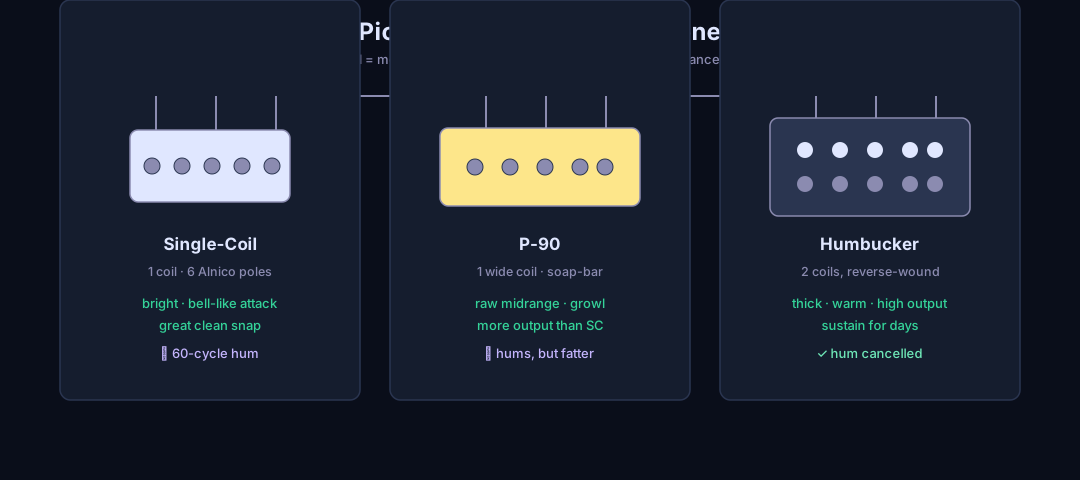 Pickup types compared: single-coil, P-90 and humbucker with pole pieces and tone character
Pickups convert string vibrations into electrical signals. Their design fundamentally shapes guitar tone.
Single-coil pickups use one coil wrapped around magnets. They produce a bright, articulate tone with strong treble response and midrange definition.
Fender-style single-coils: Alnico magnets (II, III, or V), staggered pole pieces to balance string output. Stratocaster pickups are wound with approximately 7,000-8,000 turns of 42-gauge wire. Telecaster bridge pickups have more windings (8,500-9,000 turns) for higher output.
Characteristics: Bright, cutting tone with dynamic response. Susceptible to 60-cycle hum from electrical interference. RWRP middle pickups (introduced on Strats in the 1960s) cancel hum when combined with neck or bridge.
Applications: Country twang, surf music, clean funk, blues (clean-to-light overdrive), indie rock. Jimi Hendrix used Strats to achieve his Hendrix chord inversions and octave unisons.
Humbuckers use two coils wound in opposite directions around magnets with opposite polarity. This cancels electrical hum (hence "humbucker") while producing a thicker, smoother tone with higher output.
PAF Humbuckers (Gibson, 1957): Designed by Seth Lover, the PAF (Patent Applied For) became the definitive humbucker. Alnico II or V magnets, approximately 8,000 turns per coil, unbalanced windings for "vintage" character. Resistance: approximately 7.5-8.5k ohms.
Characteristics: Warm, thick tone with smooth high end, strong midrange, and higher output than single-coils. Reduced hum and noise. Less clarity and string separation compared to single-coils, but better sustain.
Applications: Rock distortion, blues overdrive, jazz (clean), hard rock. The humbucker's thicker tone and higher output drive amplifiers into saturation more easily.
Variants: Wide Range humbuckers (Fender, designed by Seth Lover, 1972), high-output humbuckers (Ceramic magnets, over 15k ohms), split-coil humbuckers (tap to produce single-coil sound), and active humbuckers (EMG, Seymour Duncan Blackouts) with built-in preamps.
P-90s are single-coil pickups with wider, taller coils and larger magnets than Fender-style single-coils. They produce a thicker, warmer tone than traditional single-coils but brighter than humbuckers.
Characteristics: Fat, punchy midrange, bright but smooth treble, lower output than humbuckers. Less hum cancellation than humbuckers but thicker than standard single-coils. Often described as "a humbucker in single-coil clothing."
Applications: Blues, early rockabilly, punk, indie rock. Early Les Pauls (1952-1957) used P-90s; modern boutique companies reproduce vintage P-90s.
Tonewoods significantly influence guitar tone. While amplifiers and effects shape the final sound, the body and neck provide the fundamental character.
Alder: Lightweight (approx. 4 lbs), balanced tone with clear highs, strong midrange, and firm lows. Most common on Fender guitars from the 1950s onwards. Produces a "bell-like" clean tone with good sustain.
Ash: Slightly heavier than alder (approx. 5 lbs), brighter with more pronounced upper mids and clear highs. Used on early 1950s Telecasters. Produces a "snappier" attack and more string definition.
Mahogany: Heavy (approx. 5-6 lbs), warm, thick tone with strong low-mids, softer highs, and smooth attack. Used on Gibson guitars (Les Paul, SG). Provides more sustain and a "darker" character. The dense body absorbs high frequencies, creating warmth.
Basswood: Lightweight (approx. 3-4 lbs), neutral tone with flat midrange. Used on modern "Superstrat" guitars favored by shredders. Requires hotter pickups to compensate for lack of inherent character.
Rosewood: Dense, heavy, warm tone with pronounced low-end and smooth highs. Used on semi-hollow guitars and some boutique instruments.
Maple: Bright, articulate tone with strong attack and clear highs. Used on Fender necks (maple fingerboards on early Strats). Produces a "piano-like" clarity.
Mahogany: Warm, thick tone with smooth attack. Used on Gibson necks. Provides more sustain and a "creamy" character.
Rosewood/Ebony fingerboard materials: Rosewood (warmer, smoother), Ebony (brighter, articulate). Fretboard wood affects attack and sustain more than fundamental tone.
Bolt-on neck (Fender): Brighter, more articulate tone with slightly less sustain. Neck can be replaced. Used on Telecaster, Stratocaster.
Set-in neck (Gibson): Warmer, thicker tone with more sustain due to better wood coupling. Neck cannot be easily replaced. Used on Les Paul, SG.
Neck-through: Neck runs through the entire body, providing maximum sustain and resonance. Used on high-end instruments (e.g., Gibson Firebird).
The amplifier is the final stage of guitar tone. Different amplifier circuits produce distinct characters even with the same guitar.
Fender Tweed (1950s): 5E3 Deluxe, 5F6-A Bassman, 5F8-A Twin Reverb. Character: Clean-to-light overdrive with smooth breakup, glassy highs, and warm mids. Uses 6L6 or 6V6 power tubes, cathode bias (lower headroom). Favorite: Blues, country, clean jazz.
Marshall Plexi (1960s): JTM45, JMP 1959. Character: Crunchy mid-gain with aggressive mids, bright highs, and tight lows. Uses EL34 power tubes, fixed bias (higher headroom). Favorite: Classic rock, hard rock.
Vox AC30 (1960s): AC30 Top Boost. Character: Chimey clean with prominent upper mids, bell-like highs, and smooth compression. Uses EL84 power tubes (Class A operation, lower power), bright caps. Favorite: British Invasion, alternative rock.
Mesa Boogie Mark Series (1970s-1980s): Mark I, Mark II. Character: High-gain distortion with tight low-end, smooth highs, and cascading gain stages. Introduced lead channel and graphic EQ. Favorite: Hard rock, metal.
Modern modeling: Fractal Axe-FX, Kemper, Line 6 Helix. Digital emulations of classic amplifiers and effects with accurate modeling and convenience.
The order of effects affects tone and dynamics. Standard order (from guitar to amplifier):
Buffered bypass: True-bypass effects preserve tone when off but can cause signal loss in long chains. Buffered effects boost signal but can darken tone. Strategic placement of buffers preserves high-end.
What are the Big Four electric guitar body shapes? Stratocaster, Telecaster, Les Paul, and SG. Each silhouette encodes construction: bolt-on versus set neck, slab versus carved top, double cutaway versus single - and with it sustain, balance, and upper-fret access.
Do tonewoods matter on a solidbody electric guitar? Far less than pickups and amps, but not zero. Body wood shifts weight, balance, and a slice of resonance; the vibrating string is what the pickups actually hear, so hardware and setup dominate. Treat wood as feel first, tone second.
Should I choose single-coil or humbucker pickups? Single-coils are brighter and more articulate but pick up mains hum; humbuckers are warmer, louder, and quiet. Start from the music you play: country, funk, and vintage blues lean single-coil; rock, metal, and jazz lean humbucker.
Does the amplifier matter more than the guitar? For final tone, often yes - the amp is half the instrument on an electric. A modest guitar into a great amp beats the reverse in almost every blind test scenario. Budget accordingly.