Music
Music has been the counterweight to infrastructure work for as long as I can
remember: something with immediate feedback, no rollbacks, no postmortems —
just sound. This section collects what I play and how I play it.
5-String Bass
My main instrument is the 5-string electric bass. The extra low B string is
what keeps me there: it extends the range downward without retuning, which
matters in everything from soul and funk to modern worship and metal. A few
things I care about when playing:
- The low B is a foundation, not a feature. It earns its place when used
sparingly — a whole-note root under a chorus, a pedal tone through a bridge.
Flogged constantly, it turns the mix into mud.
- Muting is the real technique. Five strings, two of them thick and prone
to sympathize, mean the fretting and plucking hands both work as dampers.
Clean low end is 80% muting discipline.
- String spacing and tension drive the feel. Wider spacing forgives
fingerstyle; tighter spacing speeds up runs. Lower tension makes the B string
speak faster but floppier — it is always a trade-off.
- Groove over notes. Nobody remembers the sixteenth-note fill; everybody
remembers whether the pocket sat. I would rather play three confident notes
in the pocket than ten impressive ones outside it.
Here is the fretboard with the pattern I use most — B minor pentatonic in
first position:
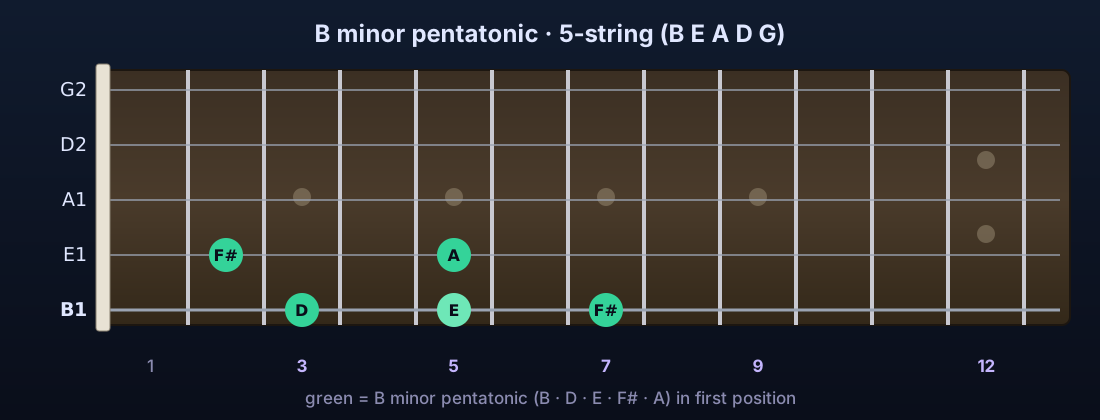 B minor pentatonic in first position on a 5-string bass: B, D, E, F-sharp and A marked on the low E and B strings
And the same shape as a tab — two bars, straight eighths: B → D → E → A,
repeated and resolved back to the root:
G|------------------|------------------|
D|------------------|------------------|
A|------------------|------------------|
E|------------5-----|------------------|
B|-0---3---5--------|-0---3---5---0----|
Music Theory
Everything above is one scale and two strings. The theory behind it:
- Open strings. B1 · E1 · A1 · D2 · G2 — the low B drops a fourth below
the standard 4-string E, which is where the extra range comes from.
- One fret = one semitone. Intervals are distances you can measure with a
finger: E→F# is two frets (a whole tone), E→G is three (a minor third).
- Minor pentatonic = 5 notes. Root, minor third, fourth, fifth, minor
seventh. On B that is B · D · E · F# · A — no b2, no b6, nothing that fights
the groove. It is the same five notes in every blues, funk, and metal song
you have ever heard.
- Learn it on the B string first. The pattern above repeats in every key
just by sliding the root. One shape, twelve keys.
For the producer side of theory — intervals, chord functions, and why a
same-note bassline works under different chords — see
Music Theory Fundamentals for Producers.
Six-String Guitar
Where it started: classical guitar on nylon strings, working through Heinz
Teuchert's guitar school — note reading, apoyando strokes, and the discipline
of playing alone and still sounding complete. The electric came later, and
with it the other half of the vocabulary:
- Tárrega for the tremolo. "Recuerdos de la Alhambra" — one melody carried
by the fastest tremolo in the repertoire, and the proof that patience is a
technique. The Teuchert school pointed exactly here.
- From Hendrix to Kravitz. "Purple Haze" remains the masterclass: one
chord (E7#9 — the "Hendrix chord"), a fuzz-drenched octave riff, and noise
used as texture with total control. Lenny Kravitz proves the same lesson in
song form — riff first, riff loud.
- B.B. King and the singing bend. The "B.B. box" — one compact position
where major and minor pentatonic meet — plus Lucille: rarely chords, mostly
single notes, vibrato from the wrist, every bend a syllable. Blues is
vocabulary, not scale practice.
- ZZ Top for economy. Billy Gibbons reduces boogie to two strings and one
attitude — proof that the space between the notes is part of the riff.
- Django Reinhardt for everything else. Two fully working fingers on the
left hand, a caravan fire that should have ended the career — and instead
"Minor Swing" and "Nuages": gypsy jazz as proof that limits are an input,
not an output.
- Tommy Emmanuel for the right hand. Fingerstyle where the thumb keeps the
bassline going while the fingers carry the melody — the bass player's logic,
applied to a single instrument. Ongoing study, worth every hour.
- Standard tuning E A D G B e. Every open-chord key lives here. The shapes
below are home base for rhythm playing in any style:
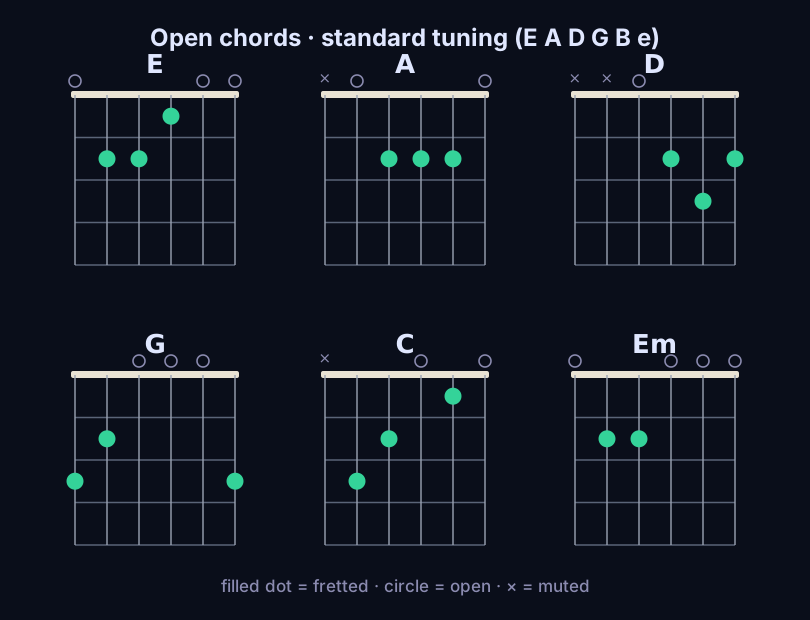 Six open guitar chords in standard tuning: E, A, D, G, C and E minor, with fretted, open, and muted string markers
For improvisation as a craft — chord melody, the ii–V–I everywhere, and
transcription as practice — see
Jazz Improvisation: Theory and Transcription Methods.
The instrument itself gets a three-part series:
- Part 1 — Body Shapes, Pickups, and the Amp Chain —
the Big Four, what silhouettes encode, pickup technology, tone woods, amps
- Part 2 — The CAGED Fretboard —
five shapes, chord tones, the pentatonic overlay
- Part 3 — Recording and DIY Setup —
mics, DI, re-amping, and the workbench: relief, action, intonation
Production
Sketches and projects live in Ableton Live — bass tracking, drum programming,
and the occasional synth line, mixed for headphones and practiced restraint.
More on specific projects here as they become listenable.
More in This Section